
Pricing


AI writer

Taplio
MCP V2
New: Engage tools
Taplio MCP V2 now available, try it out
Your AI can now comment and reply for you. It finds the posts worth engaging, drafts in your voice and queues them on your Taplio account. Nothing posts until you confirm.

How to be the comment guy on LinkedIn (and turn engagement into pipeline)

September 24, 2026

9
min read

 Open in ChatGPT
 Open in Claude
 Open in Perplexity
Key Takeaways
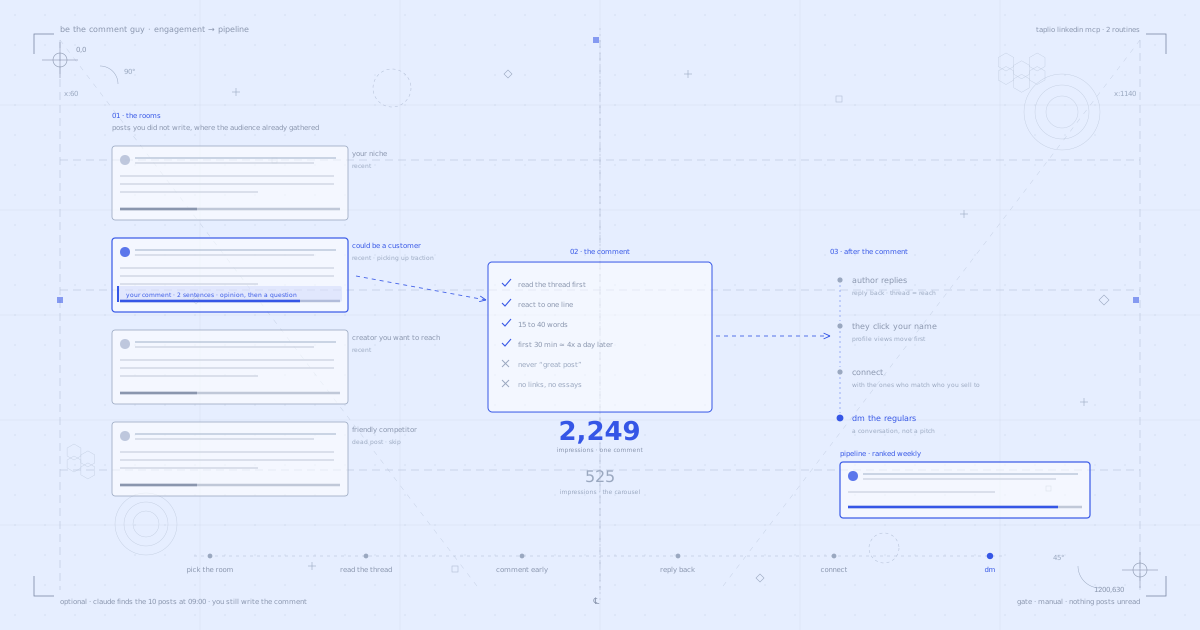
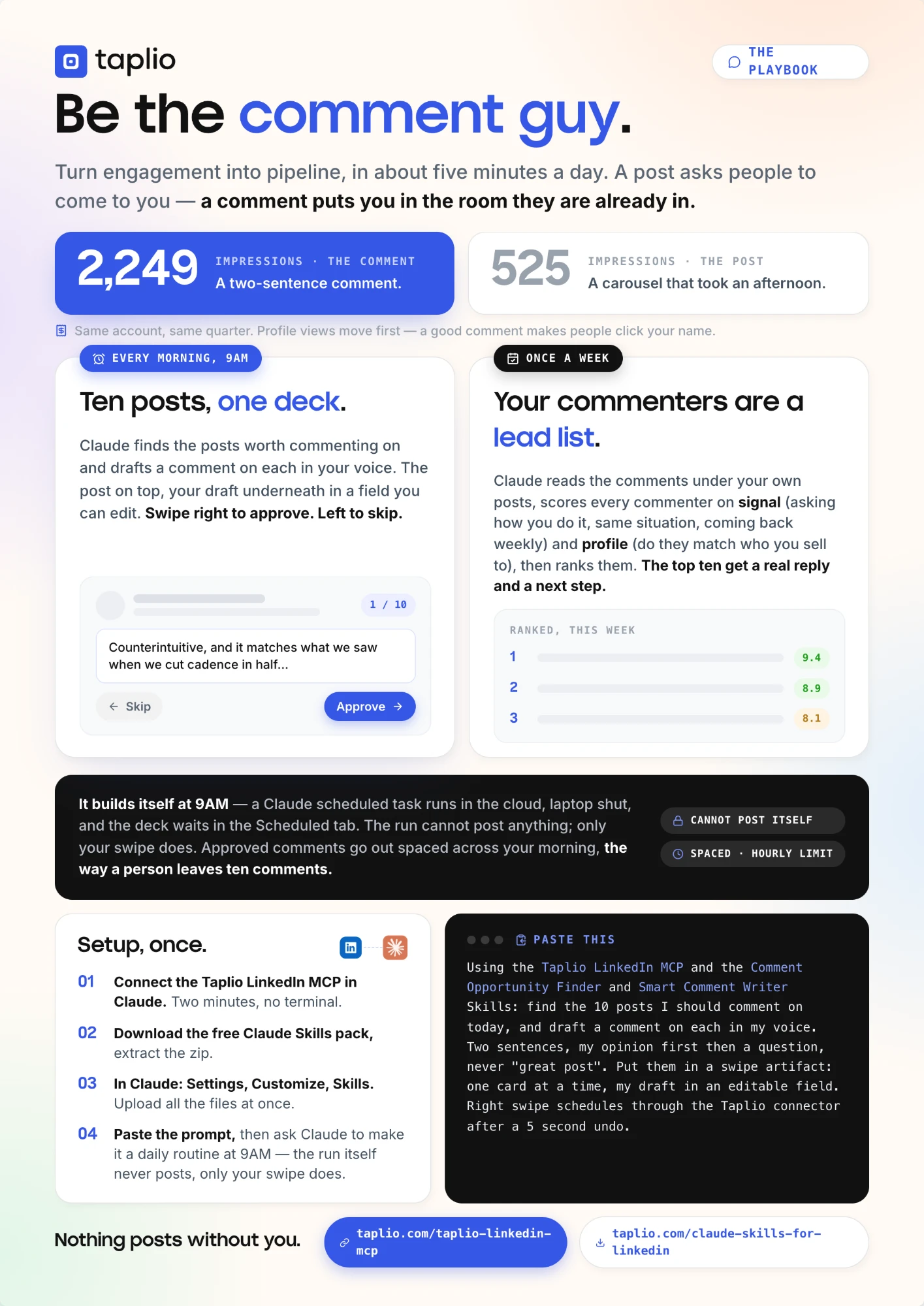
- A comment can out-reach a post 4 to 1: a two-sentence comment earned 2,249 impressions against 525 for a carousel on the same account, because a comment puts you in a room where the audience has already gathered and you chose the room.
- Only four kinds of posts deserve you: your niche, potential customers, creators whose audience you want, and friendly competitors, always recent and picking up traction, because commenting outside your lane teaches LinkedIn the wrong thing about you.
- Timing beats wit: the median comment gets about 35 impressions, and one left in the first half hour earns roughly four times what the same comment gets a day later.
- The comment is the handshake, not the conversation: reply back when the author replies (threads lift reach up to 2.4x), connect with the people who liked your comment and match who you sell to, and DM the regulars with a question rather than a pitch.
- Automate the finding, never the writing: the Taplio LinkedIn MCP and the Comment Opportunity Finder Skill surface the five posts and the angle for each, you still write and approve every comment, and nothing posts without you.
A two-sentence comment I left under someone else's post got 2,249 impressions. A carousel I spent an afternoon on got 525. Same account, same quarter.
That is the whole argument for being the comment guy: growing on LinkedIn through the comments you leave on other people's posts. Not instead of posting. As part of the strategy. A post asks people to come to you. A comment puts you in a room where the audience has already gathered, and you chose the room.
This is the playbook: which posts deserve you, how to write a comment the author replies to, why timing matters more than most people think, and what to do after. Then the one piece of it we hand to Claude and the Taplio LinkedIn MCP. If you want the launch details of the tools themselves, they are in the 2.0 launch post. This one is about the strategy.
What a comment guy actually is
Someone your niche keeps seeing in the comments. Not everywhere, and not with "great post". In the threads that matter to the people you want to reach, saying something specific, early, often enough to be recognised.
The comment compounds in a way a post does not. A good comment makes people click your name, so profile views move first. Then the next thing you publish reaches people who already recognise you, so the post lands harder. The two feed each other, which is why "comments instead of posts" is the wrong reading. The comment guy still posts. The comments are what make the posts work.
Side note, and it is the cheapest lift your own post will ever get: comment on relevant posts right before you publish and right after. You want to be visibly in the conversation when your own post goes out.
Not every post deserves you
Four kinds of posts are worth your comment. Everything else is scrolling.
- Posts from your niche. The topic you want to be known for, from anyone writing about it well.
- Posts from people who could be your customers. Where they think out loud about the problem you solve.
- Posts from creators whose audience you want. Their readers are already your readers. They have not met you yet.
- Posts from friendly competitors. Same audience, adjacent offer. A useful comment here reads as confidence.
In all four cases: recent, and picking up traction. Your comment borrows the post's reach, so a dead post is worth nothing.
This is not only about wasted effort. Richard van der Blom's analysis of 1.3 million posts found that commenting outside your lane reshapes what LinkedIn believes you are about, and your own reach pays for it. Commenting on posts that have nothing to do with your niche teaches the algorithm the wrong thing about you.
How to write a comment that gets a reply
Read the thread before the post. The fastest way to be forgettable is to say what four people have already said, and you cannot know that from the post alone.
Then pick one line in the post and react to that line. Your opinion first, then a question. Two sentences. Somewhere between fifteen and forty words, short enough that the author actually replies.
What not to do: "great post". Restating the post back to the author. A mini essay. Anything with a link in it. What works: specific to one line, a number or a polite disagreement, and a question the author wants to answer.
And write it yourself. Van der Blom estimates that around 80 percent of the comments in the first five minutes under a big post are now AI-written, and readers can tell. The comment is the one part of this routine that has to sound like you, because it is the part people read.
Be early
The median LinkedIn comment gets about 35 impressions. That is the number to beat, and timing beats it more reliably than wit.
LinkHub's study of 657,722 comments found that a comment left in the first half hour earns roughly four times the impressions of the same comment left a day later. Early comments sit at the top of a thread that is still growing. Late comments sit under a thread nobody is opening any more.
This is also the part of the routine that is hardest to do by hand. Being early on the right posts means checking the feed at the right time, every day, and knowing which of the posts in front of you are about to travel. More on that below, because it is exactly the piece we automated.
After the comment
The comment is the handshake, not the conversation. Three things happen next, and most people skip all three.
- If the author replies, reply back. AuthoredUp's analysis of nearly a million posts found that replies under a comment can lift its reach up to 2.4 times. A thread carries far more weight than a drive-by comment, and LinkedIn has said as much: a conversation under a post is the signal it shows to more people.
- Connect with the people who liked your comment and match who you sell to. They have already read something you wrote and reacted to it. That is a warmer connection request than any cold one.
- The ones who keep showing up under your own posts are a DM. Not a pitch. A question, or a thank you, or the thing you noticed about what they said.
Here is the whole argument in four minutes, with the demo at the end:
What LinkedIn has actually said about comments
Worth being precise here, because a lot of commenting advice is dressed up as algorithm fact.
What LinkedIn has said, through its editor in chief Dan Roth, is that it rewards meaningful comments over "great!" and "so true!", that it looks at whether the commenter belongs to a relevant professional community, and that a creator replying to comments tells the platform a conversation is happening and it should show the post to more people.
What LinkedIn has never said is that commenting grows the commenter's own reach or profile views. That part is creator research and first-hand receipts, including the ones at the top of this post. Treat it that way. It has held for us for a quarter, and it is cheap to test on your own account for a month.
How Taplio helps: one small piece of the routine
Done by hand, this is about an hour a day. Finding the right posts, checking they are fresh, reading the threads, working out an angle on each, writing, and doing it early enough to matter.
We do not automate the comment. We automate finding the posts and the angle, which is the half hour of scrolling, and the part where being early is decided. The Taplio LinkedIn MCP connects Claude to your LinkedIn feeds, and the free Claude Skills for LinkedIn tell Claude how to judge a post. The prompt from the video:
Using the Taplio LinkedIn MCP and the LinkedIn Comment Opportunity Finder Skill, find the 5 posts I should comment on today and tell me the angle to take on each one.Five posts from your niche, ranked, recent and picking up traction, with the line worth reacting to under each one. You still write the comment. You still approve everything.
The step after that is the one we run every morning: ten posts, a draft on each in your voice, reviewed as a swipe deck rather than a wall of text. Right to approve, left to skip, five seconds of undo.
Using the Taplio LinkedIn MCP and the LinkedIn Comment Opportunity Finder and LinkedIn Smart Comment Writer Skills: find the 10 posts I should comment on today, and draft a comment on each in my voice. Two sentences, my opinion first then a question, never "great post".

Put them in a swipe artifact: one card at a time with the post, the author, and my draft in an editable field. Swipe right to approve, left to skip. A right swipe schedules the comment through the Taplio connector after a 5 second undo. Show me a counter and what's queued.
Then one more line to make it a Claude scheduled task, so the deck is waiting at nine every morning, laptop shut:
Now make this a daily routine at 9AM. Write the full task prompt yourself so every run stands alone, and never let the run itself post anything. Only my swipe does.Approved comments are queued and spaced across your posting window rather than fired in a burst. Ten comments go out the way a person leaves ten comments, over a morning. The full walkthrough of both routines, including the weekly pass that turns your own commenters into a ranked lead list, is in the 2.0 launch post.
Nothing posts without you
Finding and drafting cannot publish anything. Only your approval queues a comment, and that holds inside a scheduled run as long as the task prompt says so, which is why the line above spells it out. Nothing goes out under your name that you have not read.
Common questions
How many comments a day is enough?
Five good ones beat twenty forgettable ones. The routine above defaults to ten because that is what fits in a five-minute review. If you only have time to comment on two posts, make them recent, in your lane, and early.
Should I let AI write my comments?
Let it find the posts and suggest the angle. Write the comment yourself, or at minimum edit every draft before it goes anywhere. The comment is the only part of this routine that people actually read, and AI-written comments are easy to spot in a thread full of them.
Does this work with a small following?
It works better with a small following, because a comment borrows the post's reach rather than depending on yours. It is the fastest way for an account nobody follows yet to be read by the right people.
Do I still need to post?
Yes. Comments make people click your name. Your profile and your posts are what they find when they do. Comment more, post as often as you can sustain, and treat the two as one system.
Start here
Pick your four kinds of posts today. Comment on three of them, early, two sentences each. Then let Claude find tomorrow's five.
Connect the Taplio LinkedIn MCP (2-minute setup)
And on October 1 we are running the whole routine live, the morning swipe deck and the weekly lead pass, end to end in Claude. Free, one hour. Save a seat here.


Keep reading
All articlesRelated Articles

.avif)
Your Linkedin AI coach is waiting for you
Join 12,000+ creators who let their coach turn the blank page into a plan and watch their audience compound.
7-day free trial · 30 day money back · Cancel anytime