
Pricing


AI writer

Taplio
MCP V2
New: Engage tools
Taplio MCP V2 now available, try it out
Your AI can now comment and reply for you. It finds the posts worth engaging, drafts in your voice and queues them on your Taplio account. Nothing posts until you confirm.

The Taplio LinkedIn MCP 2.0 is live: your whole commenting routine, inside Claude

September 17, 2026

12
min read

 Open in ChatGPT
 Open in Claude
 Open in Perplexity
Key Takeaways
- Commenting beats posting for reach you have not earned yet: a comment puts you in front of an audience that has already gathered on a post you chose, and profile views move first because a good comment makes people click your name.
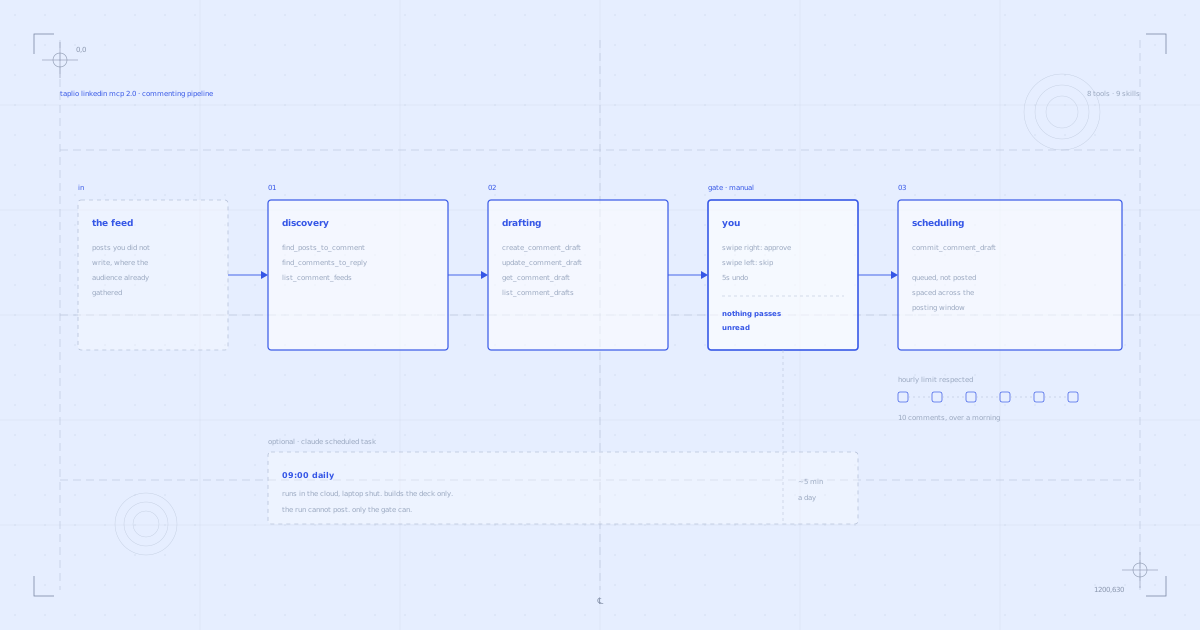
- Nothing publishes without you: discovery and drafting tools cannot post, only your approval triggers the one tool that queues a comment, and that holds inside a 9AM scheduled run as long as the task prompt says so.
- Scheduled comments are what keeps the account safe: commit_comment_draft queues rather than posts, spaces comments across your posting window and respects the hourly limit, so ten comments go out over a morning instead of in ninety seconds.
- Approval is the bottleneck, not drafting: reviewing ten drafts in a chat window means losing your place ten times, so the routine builds a swipe deck instead, one card per post with an editable draft, and reviews ten comments in about five minutes.
- The tools update themselves, the Skills do not: eight new commenting tools are already live inside the Taplio LinkedIn MCP if you have it connected, but the nine new Claude Skills need a manual download from taplio.com/claude-skills-for-linkedin and an upload into Claude under Settings, Customize, Skills.
Everyone on LinkedIn has been told to post more. Almost nobody has been told what to do with the other half of the platform, which is where the audience already is: other people's posts.
Commenting is the part that works and the part nobody sustains, because done properly it takes about an hour a day. Find the posts worth commenting on, read them well enough to say something real, write in your own voice, repeat tomorrow.
Today we shipped the fix. The Taplio LinkedIn MCP 2.0 is live, and it puts your whole commenting routine inside Claude: it finds the posts, drafts the comments in your voice, and queues them. You approve every single one before it posts.
What shipped in 2.0
Two things, and they install differently, so it is worth separating them now.
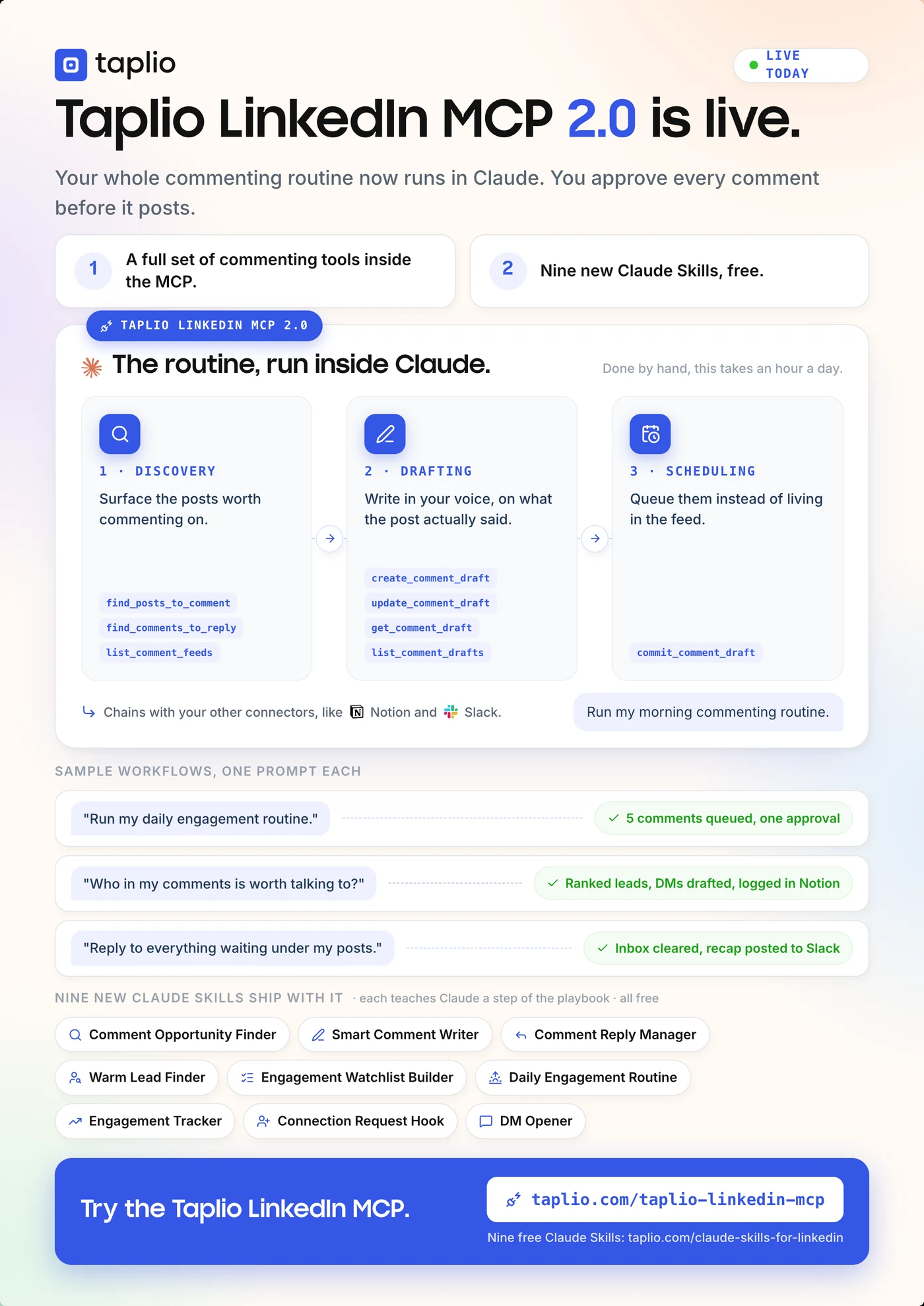
- Eight new tools inside the MCP. Discovery, drafting and scheduling for comments. These update themselves. If you already have the Taplio LinkedIn MCP connected, 2.0 is already there. Same connector, new tools, nothing to install.
- Nine new Claude Skills, free. Seven for engagement, two for networking, bringing the free library to 26. These do not update themselves. You download them once and upload them into Claude, and that is the step people skip.
Why commenting, and not more posting
A post asks people to come to you. A comment puts you in front of an audience that has already gathered, on a post you chose. You pick the room.
The metric that moves first is profile views, because a good comment makes people click your name. That is the whole mechanism: you are not borrowing someone's audience, you are earning a look from it by saying something worth reading.
The reason it fails is never the idea. It is the hour. Ten thoughtful comments a day is a real workload, and it is the first thing to go in a busy week.
What you need
- The Taplio LinkedIn MCP connected to Claude. This is what lets Claude read your feeds, draft comments and schedule them. 27 tools, two-minute setup, no terminal needed.
- Claude Skills for LinkedIn. Free instruction sets that make Claude better at a specific job. Two matter most here: the LinkedIn Comment Opportunity Finder and the LinkedIn Smart Comment Writer.
- A paid Claude plan, only if you want the routine to run itself every morning. The prompts work on any plan. Claude scheduled tasks are included on Pro, Max, Team and Enterprise.
Connect the Taplio LinkedIn MCP (2-minute setup)
Download all 26 Claude Skills for free
Setup takes about two minutes and needs no terminal either way. Here is the walkthrough for Claude, and the one for ChatGPT.
Prefer to watch the launch first, from what changed to the routine running live?
The eight new tools, in three groups
You never have to call any of these by name. You ask Claude for help with your comments and it picks the right one. They are listed here so you know what the thing can actually reach.
1. Discovery: surface the posts worth commenting on
find_posts_to_comment returns a personalised selection or a keyword search. list_comment_feeds gives you the curated creator feeds for your niche. find_comments_to_reply does the reverse and surfaces the comments still waiting under your own posts.
2. Drafting: write it, and let you change it
create_comment_draft, update_comment_draft, get_comment_draft and list_comment_drafts. Everything at this stage is a draft. Nothing has touched LinkedIn yet.
3. Scheduling: queue it and report back
commit_comment_draft is the only tool in the set that sends anything anywhere, and it schedules rather than posts. More on that below, because it is the part that keeps your account safe.
The nine new Claude Skills, and how to actually get them
Skills are saved instructions for Claude. You install one once, and every prompt you write afterwards gets shorter, because you stop re-explaining how you want the job done.
Seven new engagement Skills:
- Comment Opportunity Finder. Ranks today's posts by how likely they are to be worth your time, and gives you the angle to take on each one.
- Smart Comment Writer. Three options on one angle, ranked by how likely each is to get a reply. Built specifically to avoid the generic ones.
- Comment Reply Manager. Clears the inbox of comments waiting under your own posts.
- Warm Lead Finder. Reads who commented on your posts and ranks which of them are worth a conversation.
- Engagement Watchlist Builder. Builds a bench of 10 to 15 creators, split into reach targets and peers.
- Daily Engagement Routine. Runs the whole session end to end with one approval at the end.
- Engagement Tracker. What posted, what failed, and why.
And two for networking:
- Connection Request Hook. Three requests ranked by acceptance likelihood.
- DM Opener. The first message after someone accepts, written to open a conversation rather than pitch.
To install them: go to taplio.com/claude-skills-for-linkedin and download the pack. Extract the zip. In Claude, open Settings, then Customize, then Skills, and upload all the files at once rather than one at a time. It takes about forty seconds and you get the whole library of 26, not only today's nine.
Commenting at scale is safe, because comments are queued and not fired
This is the part worth understanding before you run anything at volume.
Your approved comments do not go out the moment you approve them. Taplio queues them, spaces them across your posting window, and holds them back when you have hit the hourly limit. Ten comments go out the way a person leaves ten comments, over a morning. Not ten in ninety seconds, which is the pattern that gets accounts flagged.
You do not configure any of this. It is how commit_comment_draft behaves by default.
How we started using MCP 2.0
We built two routines on it in the first week. The first one runs every morning and handles reach. The second one runs once a week and handles pipeline. Both are one prompt.
Routine 1: the morning swipe deck
The problem with AI-drafted comments was never the drafting. It is the approving. Ten drafts in a chat window means scrolling, losing your place, and deciding ten separate times whether something sounds like you. So we stopped reading them as a list and had Claude build a deck instead: one card at a time, the post on top, your draft underneath in a field you can edit.
The prompt that builds it:
Using the Taplio LinkedIn MCP and the LinkedIn Comment Opportunity Finder and LinkedIn Smart Comment Writer Skills: find the 10 posts I should comment on today, and draft a comment on each in my voice. Two sentences, my opinion first then a question, never "great post".

Put them in a swipe artifact: one card at a time with the post, the author, and my draft in an editable field. Swipe right to approve, left to skip. A right swipe schedules the comment through the Taplio connector after a 5 second undo. Show me a counter and what's queued.
Swipe right to approve, left to skip. Edit anything you would not have said before you approve it. There is a five second undo on each card, and a running counter of what is queued. Ten comments reviewed in about five minutes.
Before the next prompt: what a Claude scheduled task is
If you have not used one, this is the reveal, and it is the difference between a trick you did once and a routine that runs without you.
A scheduled task is a prompt Claude runs on a schedule you choose, on its own. It runs in the cloud, which means it keeps going when your laptop is shut and Claude is closed. The result is waiting for you in the Scheduled tab when you next open the app. Your connectors and your Skills work inside a scheduled run exactly as they do in a normal conversation, so a scheduled task can reach the Taplio LinkedIn MCP and use the Skills you installed.
Scheduled tasks are included on paid Claude plans: Pro, Max, Team and Enterprise.
Then make it run at 9AM
Now make this a daily routine at 9AM. Write the full task prompt yourself so every run stands alone, and never let the run itself post anything. Only my swipe does.That second sentence is doing real work. It tells Claude to write a task prompt that carries its own context, because a scheduled run has no memory of this conversation. The third sentence keeps the run unable to publish. The deck gets built at nine every morning. Approving it stays a thing only you can do.
Here is the whole routine running, end to end:
Routine 2: turn your comments into a lead list
The first routine is about reach. This one is about what reach is for.
The people commenting on your posts are a lead list, and almost nobody reads them that way. Most comments are praise, and praise is not a signal.
There are two things worth checking on every comment. Signal: are they asking how you actually do it, describing the same situation, coming back week after week, pushing back politely. Profile: what they actually do. A great comment from someone you will never sell to is a good moment, not a lead. You need both, and one without the other is noise.
So instead of reading the comments, we score them on both. The block at the top of the prompt is the part you fill in once:
Using the Taplio LinkedIn MCP and the LinkedIn Warm Lead Finder Skill, turn last month's comments into a lead list.

----- FILL THIS IN FIRST -----
My target audience: [ e.g. early-stage founders, VCs, B2B marketers ]
What counts as a lead: [ e.g. product pipeline / newsletter audience / both, tagged ]
Window: [ last 30 days ]
How many leads I want: [ 10 ]
Already connected to: [ list names, or write ASK ME ]
------------------------------

1. Read the comments under my own posts from the window above, up to 10 posts, which is the cap per call. If that window holds fewer than 3 posts, widen it until it does and tell me exactly what you widened to. Flag up front that the MCP only returns comments I have not replied to yet, so the sample is partial.

2. Match each commenter's headline against my target audience, then score intent. Mark anyone who sells what I sell as a peer rather than a lead, and say why they are still worth knowing.

3. Give me a ranked table: who they are, what they said, which post it was under, and why they scored where they did.

4. For the top ten, draft the reply that keeps the conversation going. Never invent a link or a product URL. If a reply needs one, leave a placeholder and ask me for it.

5. Before writing any outreach, confirm connection status with me. Then run the LinkedIn Connection Request Hook Skill for the ones I am not connected to, and the LinkedIn DM Opener Skill for the ones I am. Three options each, ranked, with character counts.

Show me all of it before you schedule a single reply.
You get a ranked table, and the column worth arguing with is the last one: why each person scored where they did.
Two caveats it states up front, and both matter. It only sees comments you have not replied to yet, so the sample is partial. And it caps at ten posts per run.
How it keeps the comments sounding like you
This is the part that separates it from the AI comment generators you have already dismissed, so it is worth spelling out.
- It reads the thread, not only the post. Including the comments already under it. The fastest way to write something forgettable is to say the thing four people have already said, and a tool that reads only the post cannot know that.
- It knows your niche. The MCP pulls your profile, your topics and who you are trying to reach, so the angle it takes is one that makes sense coming from you. A comment that lands from a recruiter does not land from a founder.
- It writes to your format. Two sentences, opinion first, then a question, in the example above. Change that to whatever you actually sound like and the Skills hold to it.
- It gives you three options, not one. Three angles on the same post, ranked by likelihood of a reply. Pick one, edit it, or bin all three.
- You review one at a time. A card per post beats a wall of text, which is the entire reason the deck exists.
Nothing posts without you
Drafting and scheduling are separate steps on purpose. The discovery and drafting tools cannot publish anything. Only commit_comment_draft queues a comment, and it only runs when you approve one.
That holds inside scheduled runs too, as long as your task prompt says so, which is why the prompt above spells it out. Nothing goes out under your name that you have not read.
Common questions
Do I need to reinstall the MCP to get 2.0?
No. The tools update on the server. If the Taplio LinkedIn MCP is already connected in Claude, the eight new commenting tools are already available to you. The Skills are the only part you have to download.
Does it work in ChatGPT?
The MCP does, along with any other MCP client. Claude Skills and Claude scheduled tasks are Claude features, so the one-prompt-and-a-deck version of this routine is a Claude workflow.
Will this get my account restricted?
Comments are scheduled and spaced across your posting window rather than fired in a burst, and the queue respects the hourly limit. That is the behaviour that matters. Volume is not what gets accounts flagged. Volume in ninety seconds is.
Can I use it for replies under my own posts as well?
Yes. find_comments_to_reply surfaces what is still waiting, and the Comment Reply Manager Skill handles the triage. One caveat worth knowing: it returns comments you have not replied to yet, so treat the sample as partial.
Start here
Connect the MCP first, download the Skills second, run prompt 1 third. The whole thing takes under five minutes and you will know within one run whether the drafts sound like you.


Keep reading
All articlesRelated Articles


.avif)
Your Linkedin AI coach is waiting for you
Join 12,000+ creators who let their coach turn the blank page into a plan and watch their audience compound.
7-day free trial · 30 day money back · Cancel anytime
AVG. VIEWS
2,979
-1.5%
ENGAGEMENT
3.2%
+0.8%

Free Monthly Report
How does your LinkedIn compare?
Get free monthly benchmarks on reach, engagement, and content format performance.
Get the Benchmark