



2,847 creators joined this month
Grow your LinkedIn audience 3x faster
AI writing, carousel maker, scheduling, analytics, and lead finder. All in one tool.
Try Taplio for free7 day free trial - Money back guarantee

I recently saw a CEO post a generic corporate press release that got three likes, while a junior sales rep shared a messy, honest “lesson learned” from a lost deal that generated ten inbound leads in 48 hours.
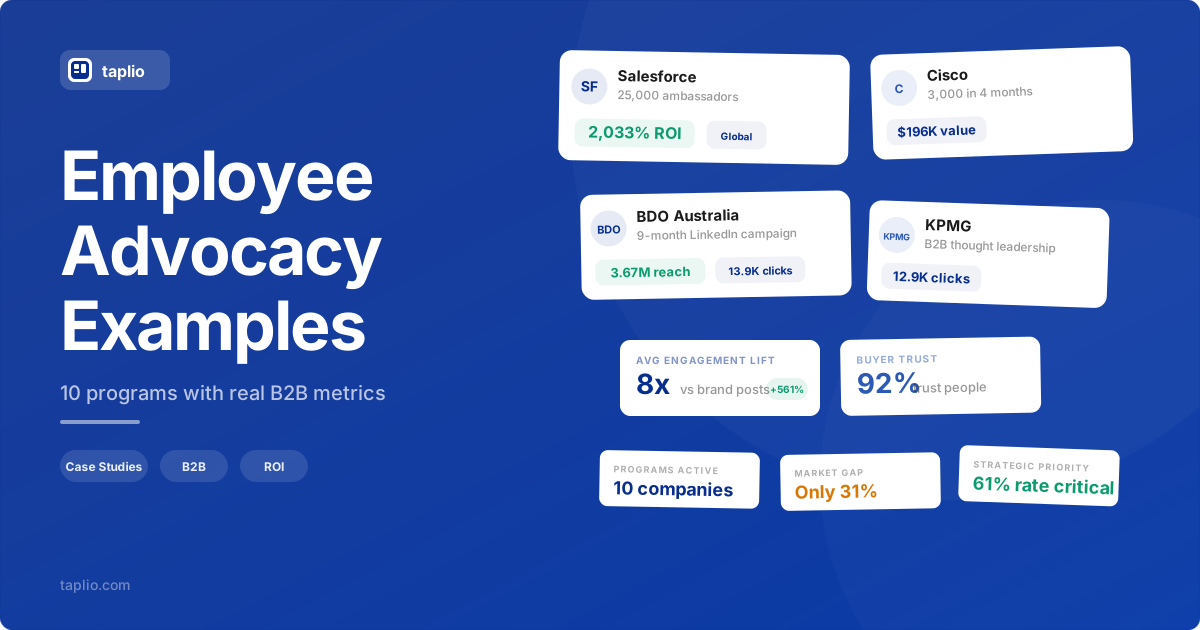
The math is simple: 92% of B2B buyers trust recommendations from people they know, yet only 31% of companies have a formal program to tap into that trust. If you are still relying solely on your corporate page to carry your message, you are shouting into a vacuum while your competitors are building empires through their people.
This guide is my blueprint for closing the “enablement gap”. I will show you how to move from random posting to a structured system that empowers your team to share their expertise, without turning them into corporate robots.
I define employee advocacy as the voluntary promotion of a company by the people who work there. It is a strategic approach where team members share their professional expertise across their personal social networks and offline channels.
There is a clear distinction between a program that drives results and one that feels like “advocacy-washing”:
While the core strategy remains the same, the choice of platform depends on your specific business goals:
Leaders often require concrete data before committing to a new approach. In these situations, I highlight the metrics showing the superiority of people-led marketing. This provides the undeniable proof necessary to gain approval from the C-suite.
The trust factor is the foundation of this model, as 92% of buyers trust recommendations from people they know over traditional advertisements. This personal connection translates into massive algorithmic reach because employee networks typically have 10x more connections than corporate follower counts.
Research from 2025 further shows that employee-shared content earns about 8x higher engagement than identical content published via corporate channels.
This high-performance approach creates a significant departmental impact across the entire organization. Marketing teams see an immediate increase in organic reach, while Sales teams leverage social selling to grow the pipeline. HR also benefits through stronger employer branding that improves recruiting efforts.
The industry is maturing from ad-hoc posts to tech-enabled systems, and aligning your program with a modern LinkedIn marketing strategy ensures you stay ahead of these trends.
I find that long-term results depend on the professional growth of the individual; if advocacy feels like a chore, it fails. A successful program requires a clear “What’s In It For Me” (WIIFM) factor to ensure participation remains entirely voluntary.
Helping your team understand this value through our guide on LinkedIn personal branding is a critical step in building a sustainable program.
I have seen countless programs fail because leadership tried to use social media to paper over a toxic office culture. You cannot advocacy-wash poor internal morale; authentic programs require a foundation of trust that a marketing budget simply cannot buy.
Voluntary participation is a must for employee advocacy programs, because coercion leads to robotic content that audiences and social algorithms eventually ignore. Programs that force participation without a healthy culture often backfire as employees may resist sharing content entirely. Success ultimately depends on executives modeling the behavior first to show the entire team that a digital presence is a valued professional asset.
Building this cultural readiness is the ultimate gatekeeper for long-term sustainability.
I have learned that the fastest way to kill a program is to launch it to the entire company on day one without a plan. To build something sustainable, you need a streamlined roadmap that moves from strategy to execution.
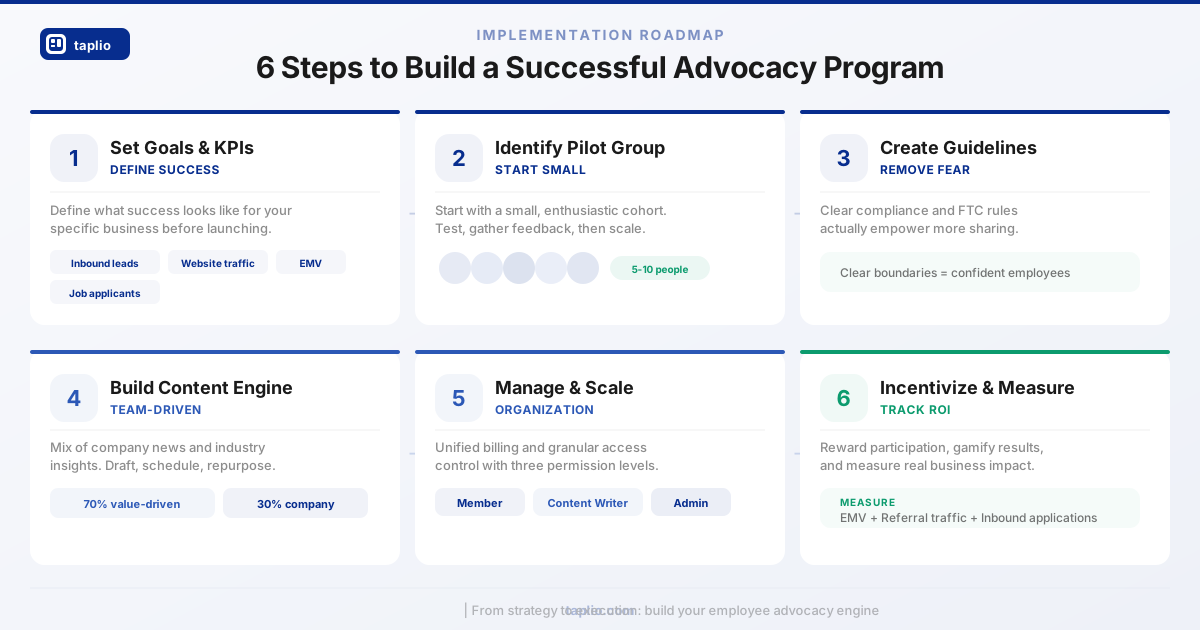
Set goals & KPIs: You must define what success looks like for your specific business. Common metrics include inbound job applicants, increased website traffic, or earned media value.
Identify a pilot group: I recommend starting with a small, enthusiastic cohort rather than a massive rollout. This allows you to test your LinkedIn marketing strategy and gather feedback before scaling.
Create clear social media guidelines: You can remove the “fear of posting” by providing easy-to-understand compliance and FTC rules. Clear boundaries actually empower employees to share more freely.
Developing a team-driven content engine is the next phase. You should provide a mix of company news and industry insights so the content remains valuable to the audience. Using a tool like Taplio allows your team to seamlessly draft, schedule, and repurpose content together. You can stay organized by using a LinkedIn content calendar to ensure a consistent presence.
Managing your organization efficiently becomes simple when you set up your program in Taplio. It simplifies operations via unified billing for all accounts and offers granular access control. You can assign three specific permissions to manage the workflow:
Finally, you must incentivize, gamify, and monitor the results. Rewarding participation keeps energy high, but you must focus on quality to avoid encouraging spam. Utilizing the LinkedIn analytics tool and Taplio’s team performance dashboards allows you to see how the entire team or particular individuals perform in real-time.
I have found that “blank page syndrome” is the biggest killer of consistency in any advocacy program. To keep your team active without making them sound like a corporate brochure, you need a practical content matrix.
The most important rule is to maintain a healthy balance where not every post centers on the company. A good rule of thumb is the 4-1-1 rule or a 70/30 split, where 70% of the content is personal or value-driven and only 30% is company-related. This ensures your team builds authentic authority rather than just acting as a megaphone.
To make this sustainable, I suggest organizing content into four specific buckets:
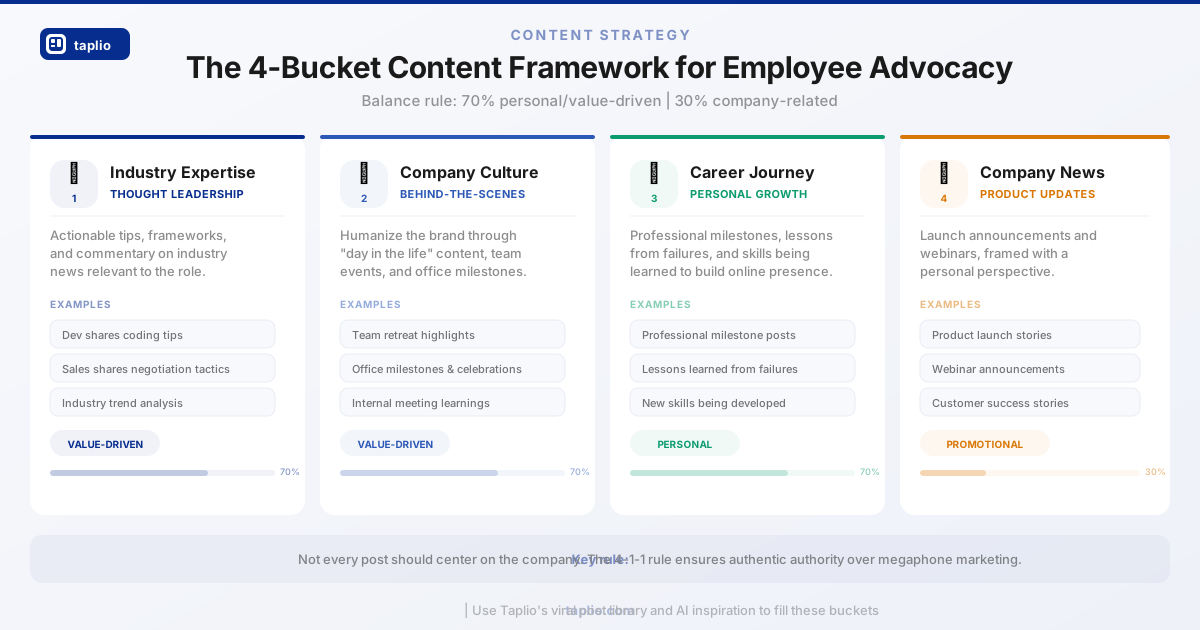
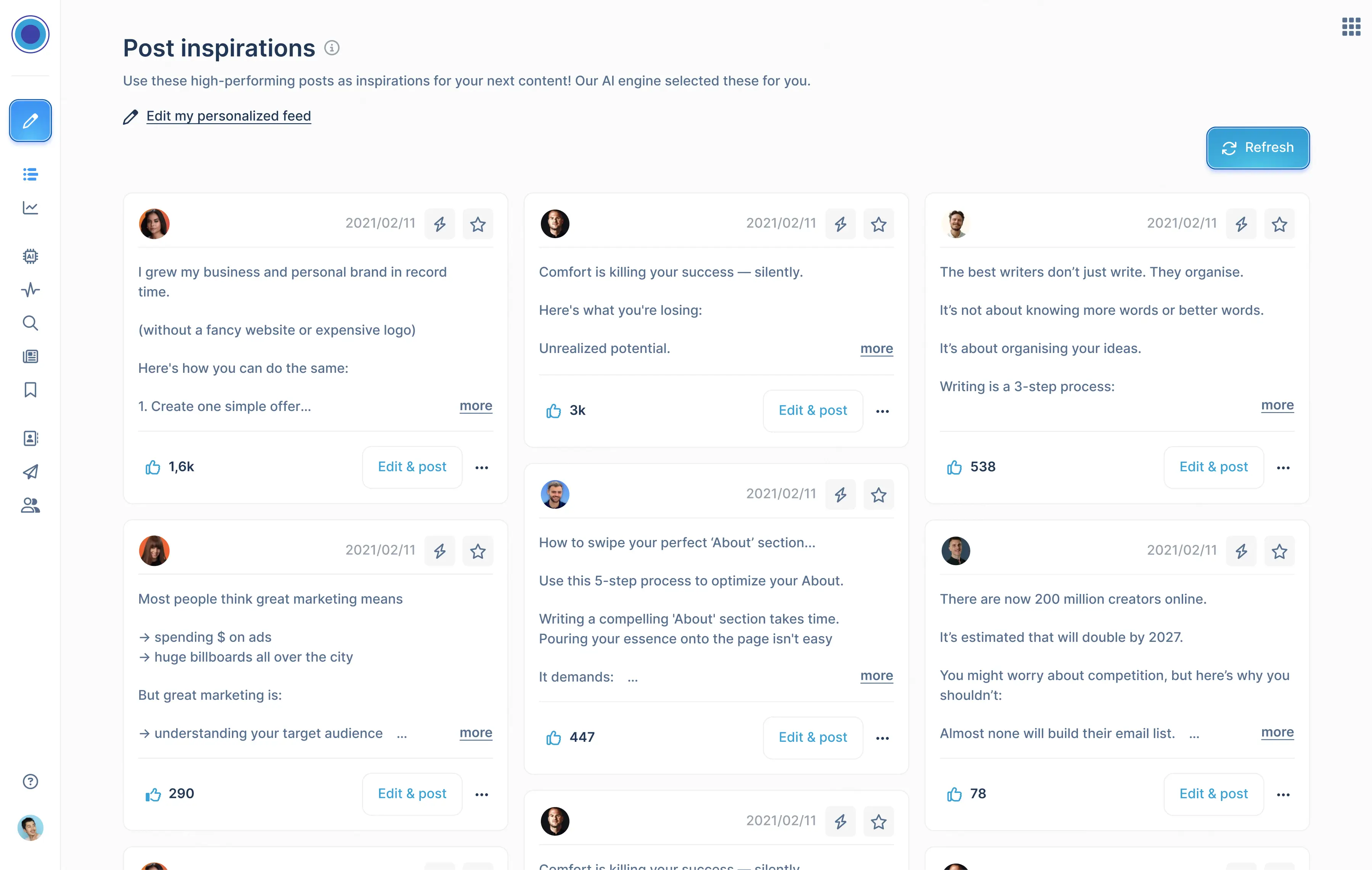
Taplio tip: Your team can easily overcome the struggle of what to write by using Taplio’s viral post library and AI inspiration features. These tools help find proven formats to fill these buckets quickly, ensuring everyone stays consistent.
Choosing the right technology is a critical step in scaling a program from a manual effort to a high-performance engine. Most organizations graduate from spreadsheets and internal emails to a dedicated platform once they reach approximately 50 active advocates. At this scale, manual tracking becomes inefficient and prevents the program from reaching its full potential.
When evaluating potential software, specific features are necessary to remove friction and ensure long-term participation:
Taplio provides these essential features through a platform designed specifically for the modern social landscape. It offers an organization-level motion that supports employee-generated content while simplifying operations. Key capabilities include unified billing for all accounts and granular access controls with three distinct permission levels: member, content writer, and admin.
I am convinced that a program without measurement is just a hobby, and the board rarely funds hobbies. While the challenge of multi-touch attribution in social media is real, I rely on a specific framework to separate vanity metrics from actual business outcomes.
I prioritize the internal pulse of the program before worrying about external reach. You should track these specific indicators to gauge if your strategy is actually sticking:
Native LinkedIn dashboards provide basic information, but they are often too slow for managing a high-performance team. I recommend using Taplio to access this data much more efficiently with these steps:
Pro tip: Sort post performance from best to worst to identify which formats to replicate next.
Ultimately, I tie every activity back to the bottom line. You should track business impact metrics like Earned Media Value (EMV), referral traffic to your site, and the number of inbound job applications. By connecting these to a complete LinkedIn analytics guide, you can prove the financial viability of your advocacy efforts.
My conviction is that the future of brand growth belongs to the companies that humanize their workforce. Employee advocacy is no longer an optional experiment; it is the most effective way to cut through the noise and build a foundation of trust that traditional ads cannot replicate. By empowering your team to share their expertise, you turn your organization from an impersonal entity into a group of recognized industry experts.
The path from a quiet workforce to a high-impact advocacy engine starts with the right strategy and the right tools.
Get started with Taplio to launch your program today.
A classic example is a software company where the engineering team shares “behind-the-scenes” looks at how they solve complex problems, while the sales team shares industry insights and customer success stories. Instead of the company account posting a generic link, 50 different employees share that link with their own unique take.
The primary advantage is a massive increase in organic reach and trust. Because people trust individuals more than brands, you see higher engagement rates, a more qualified sales pipeline, and a stronger employer brand that attracts top-tier talent.
You must focus on the “What’s In It For Me” factor. Participation thrives when employees realize that posting helps them build a personal brand and grow their professional network. Removing the “fear of posting” with clear guidelines and providing a tool like Taplio to make content creation easy is the best way to ensure high adoption.
Influencer marketing involves paying external creators to promote your brand to their audience. Employee advocacy relies on your own team’s genuine expertise and existing professional relationships. Advocacy is an internal, long-term cultural shift, while influencer marketing is an external, campaign-based transaction.
While you can start manually with a small team, software becomes necessary as soon as you want to scale or track ROI. If you have more than 10-15 people active, a dedicated platform ensures everyone stays on brand and allows you to measure the actual business impact without wasting hours on manual spreadsheets.
AI writing, carousel maker, scheduling, analytics, and lead finder. All in one tool.
Try Taplio for free
Get free monthly benchmarks on reach, engagement, and content format performance.
Get the Benchmark






.png)
