
Pricing


AI writer

Taplio
MCP V2
New: Engage tools
Taplio MCP V2 now available, try it out
Your AI can now comment and reply for you. It finds the posts worth engaging, drafts in your voice and queues them on your Taplio account. Nothing posts until you confirm.

10 Best Taplio Alternatives in 2026 (an Honest Comparison)

July 23, 2026

13
min read

 Open in ChatGPT
 Open in Claude
 Open in Perplexity

Key Takeaways
- Best Taplio alternatives: Supergrow is the closest replacement at $19/month ($16/month annual) with AI voice training included from the first dollar, while Taplio itself has no free plan and its $39/month Starter plan excludes AI writing, which begins on Growth at $69/month.
- The other main options: AuthoredUp at $19.95/month is best for formatting, previews and 300+ hook templates with no AI generation, Buffer at $5 per channel per month is best for cheap multi-network scheduling, and Kleo at $99/month bundles templates with weekly live coaching.
- The number that decides: AI writing on Taplio starts at $69/month (Growth), the single most common complaint in third-party reviews, so any budget capped near $40/month points to Supergrow ($19/month) or MagicPost ($21/month).
- What to check before choosing: writing help (AI or craft tools), scheduling depth, analytics quality, engagement and lead features, price for what you get, plus seat limits, monthly AI caps and whether a trial needs a card.
- Decision rule: Choose Supergrow if price is the first filter, AuthoredUp if AI should never touch drafts, Buffer or Typefully if LinkedIn is one channel among several, and Taplio if the viral post database, AI writing, scheduling, engagement and analytics must sit in one subscription.
Let's address the elephant in the room: you are reading a "Taplio alternatives" article on the Taplio blog. Most companies would use this page to tell you every competitor is terrible. We are not going to do that, because you would see through it in about four seconds.
Instead, here is what this page actually is: an honest map of the LinkedIn tools market in 2026, written by people who study it every single day. We tested the alternatives, we read what their users say, and we will tell you exactly when one of them is a better fit than us. We will also tell you when it is not, and why.
One thing you will not get from the other listicles ranking for this keyword: most of them are written by the competitors themselves, and several still recommend tools that no longer exist. Shield, for example, announced it is winding down. We keep this page updated because our name is on it, literally.
Taplio alternatives at a glance
| Tool | Best for | LinkedIn only? | Starting price | Free option |
|---|---|---|---|---|
| Taplio | All-in-one LinkedIn growth (write, schedule, engage, analyze) | Yes | $39/mo ($32/mo annual) | 7-day full Pro trial + free tools |
| Supergrow | Budget-friendly AI writing with voice training | Yes | $19/mo ($16/mo annual) | 7-day trial |
| AuthoredUp | Formatting, previews, and post analytics (no AI generation) | Yes | $19.95/mo ($16.63/mo annual) | Trial, no card needed |
| Kleo | Templates plus live coaching and community | Yes | $99/mo ($999/yr) | No trial |
| MagicPost | Simple AI post generation on a budget | Yes | $21/mo | Trial, no card needed |
| ContentIn | AI ghostwriting trained on your style | Yes | Free to start | Free scheduler plan |
| Typefully | Minimalist cross-platform writing | No (X, LinkedIn, Threads, Bluesky) | Free plan, paid for higher limits | Free: 15 posts/mo |
| Buffer | Cheap multi-platform scheduling | No | $5/channel/mo | Free: 3 channels |
| Hootsuite | Enterprise social media teams | No | $99/user/mo (annual) | 14-day trial |
How we evaluated these tools
So you can judge whether to trust this list, here is the method behind it. Every price on this page was pulled from each tool's public pricing page in July 2026, not copied from another listicle (that is how half the articles ranking for this keyword ended up recommending a product that shut down). Every screenshot was captured by us, this month.
We scored each tool on five criteria: writing help (AI or craft tools), scheduling depth, analytics quality, engagement and lead features, and price for what you get. We also read third-party reviews of every tool, including the reviews of Taplio itself, and we quote the criticism instead of hiding it.
What we did not do: rank tools by affiliate commission (there are no affiliate links on this page) or bury the competitors that scare us the most. Supergrow is listed first for a reason.
Why people look for Taplio alternatives (the honest version)
If we want you to trust the rest of this page, we have to start with the uncomfortable part. People search for alternatives to Taplio for three main reasons, and all three deserve a straight answer.
1. The Starter plan does not include AI writing
This is the number one complaint in third-party reviews, so let's be clear about it. Taplio's Starter plan at $39/mo covers scheduling, analytics, and consistency tools. AI writing starts with the Growth plan at $69/mo, and unlimited AI comes with Pro.
If you came in expecting AI generation at $39, we understand the frustration, and this page now says it plainly. If your budget stops at $40/mo and AI writing is your priority, Supergrow or MagicPost will serve you better. That is not a trap, it is just positioning: Starter is for people who already write well and need structure.
2. AI output that needs editing
Every AI writing tool produces drafts that need your judgment, ours included. Some reviewers say Taplio's AI "sounds generic" when you generate a post from a bare topic with zero personal input. They are right, and the same is true of every tool on this list, whatever their landing page promises.
The difference between tools is how much context they capture: your past posts, your voice, your stories. Taplio grounds drafts in a database of over 5 million LinkedIn posts plus your own history. Supergrow and ContentIn train on your writing style. AuthoredUp skips generation entirely. Pick the philosophy that matches how you write.
3. Questions about account safety
You may have seen "Is Taplio banned by LinkedIn?" in Google's suggested questions, mostly fueled by competitor blog posts. The short answer: no. Thousands of creators use Taplio every day to write, schedule, and publish, and posting through Taplio is the core of the product.
The longer answer is that any third-party tool with engagement automation, ours and everyone else's, should be used with sane limits. Taplio ships with conservative rate limits by design, and the features that carry the most risk on other platforms (mass connection requests, aggressive auto-DMs) are exactly the ones we keep on a tight leash. If a tool promises unlimited automated outreach with zero risk, walk away.
The 8 best Taplio alternatives in 2026
Ranked by how often they genuinely make sense as a replacement, based on what each one does best. For each tool you get real 2026 pricing, the good, the bad, and the one case where we would pick it over Taplio.
1. Supergrow: the budget all-rounder
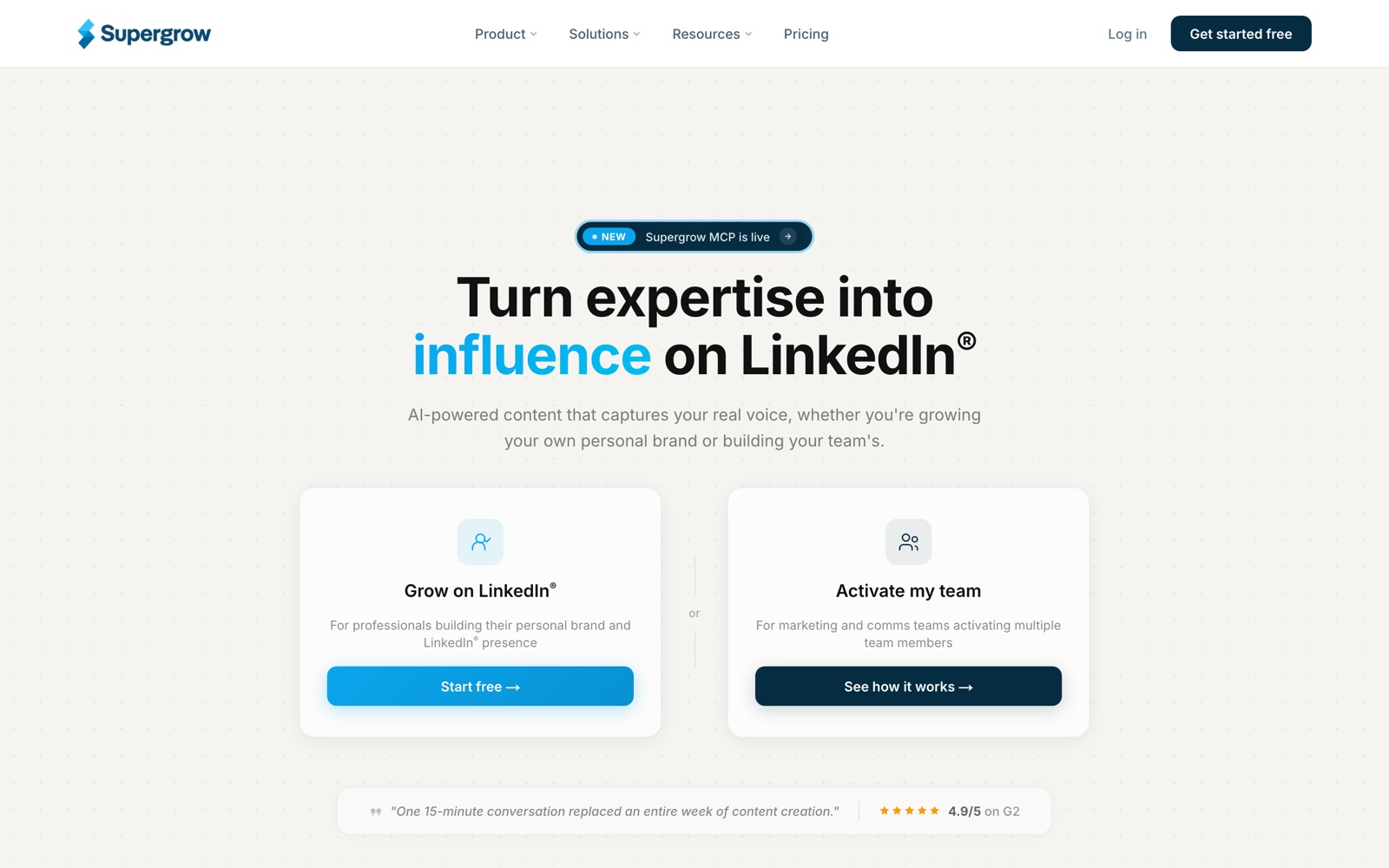
Supergrow is the alternative we get compared to most, and for good reason. It is a LinkedIn-only tool with AI writing trained on your voice, a carousel maker, scheduling, and analytics, at roughly half our entry price. Their users rate it highly (they display a 4.9/5 G2 badge on their homepage), and the product ships fast.
Best for: solo creators writing their first 100 LinkedIn posts on a tight budget.
What you get: the Starter plan at $19/mo ($16/mo billed annually) includes their Content DNA voice training, post repurposing from YouTube videos, articles, and PDFs, scheduling with a calendar view, a kanban pipeline for drafts, and auto first-comment. Pro at $39/mo ($31 annual) adds unlimited Postcast sessions (an AI that interviews you, then drafts posts from your answers), the carousel maker, an infographic generator, profile analytics, and their own MCP integration.
The good: AI included from the first dollar, a genuinely clever interview-to-post workflow, and a 7-day trial with no card required.
The bad: Starter caps Postcast at 2 sessions per month, which you will hit in week one if you post daily. There is no viral content database to mine for proven ideas, no lead management layer, and Teams pricing jumps to $139/mo for 4 accounts, which erases most of the price advantage for small teams.
Pick it over Taplio if: price is your first filter and you mostly need writing help. For the full head-to-head, read our Taplio vs Supergrow comparison or our Supergrow review.
2. AuthoredUp: for writers who want tools, not a ghostwriter
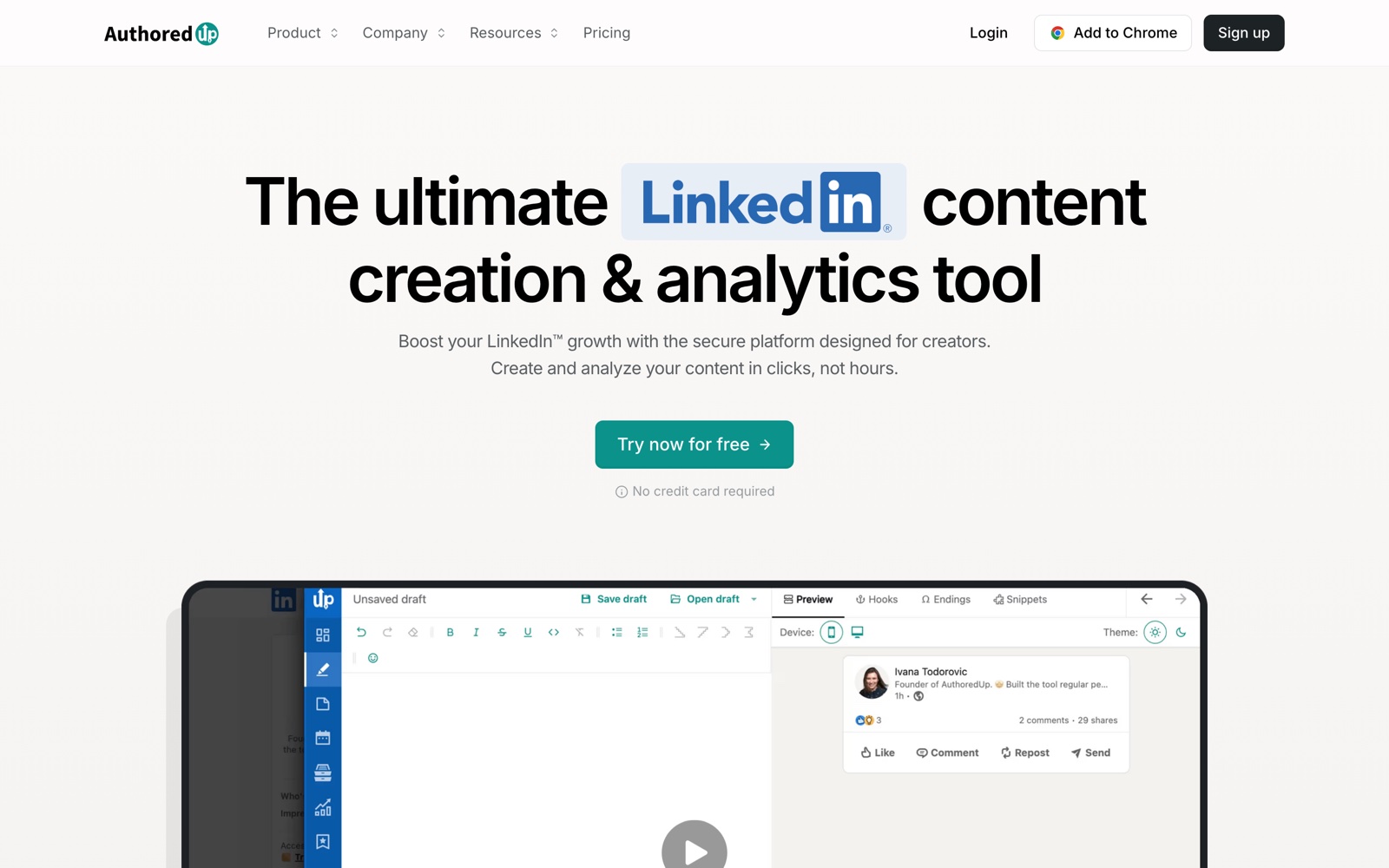
AuthoredUp takes the opposite bet from most tools on this list: no AI generation at all, on purpose. It gives you a rich editor with bold and italic formatting, live previews on desktop and mobile, more than 300 hook and ending templates, reusable snippets, and detailed post analytics with full post history.
Best for: people who enjoy writing their own posts and want better craft, not automation.
What you get: $19.95/mo for one profile, or $16.63/mo billed annually ($199.50/year). The Business plan at $14.95 per profile per month (3 profile minimum) adds team sub-accounts, shared drafts, and team-wide analytics. Company page management is included free on both plans, and the trial requires no card.
The good: the best formatting and preview workflow in the category, unlimited drafts and snippets, and a pricing model with zero surprises.
The bad: you write everything yourself. No idea generation, no viral post database, no scheduling intelligence beyond the calendar, and no lead features. It complements a content brain rather than replacing one.
Pick it over Taplio if: you would never let AI touch your drafts anyway. Full breakdown in our Taplio vs AuthoredUp comparison and AuthoredUp review.
3. Kleo: templates plus coaching, at a premium
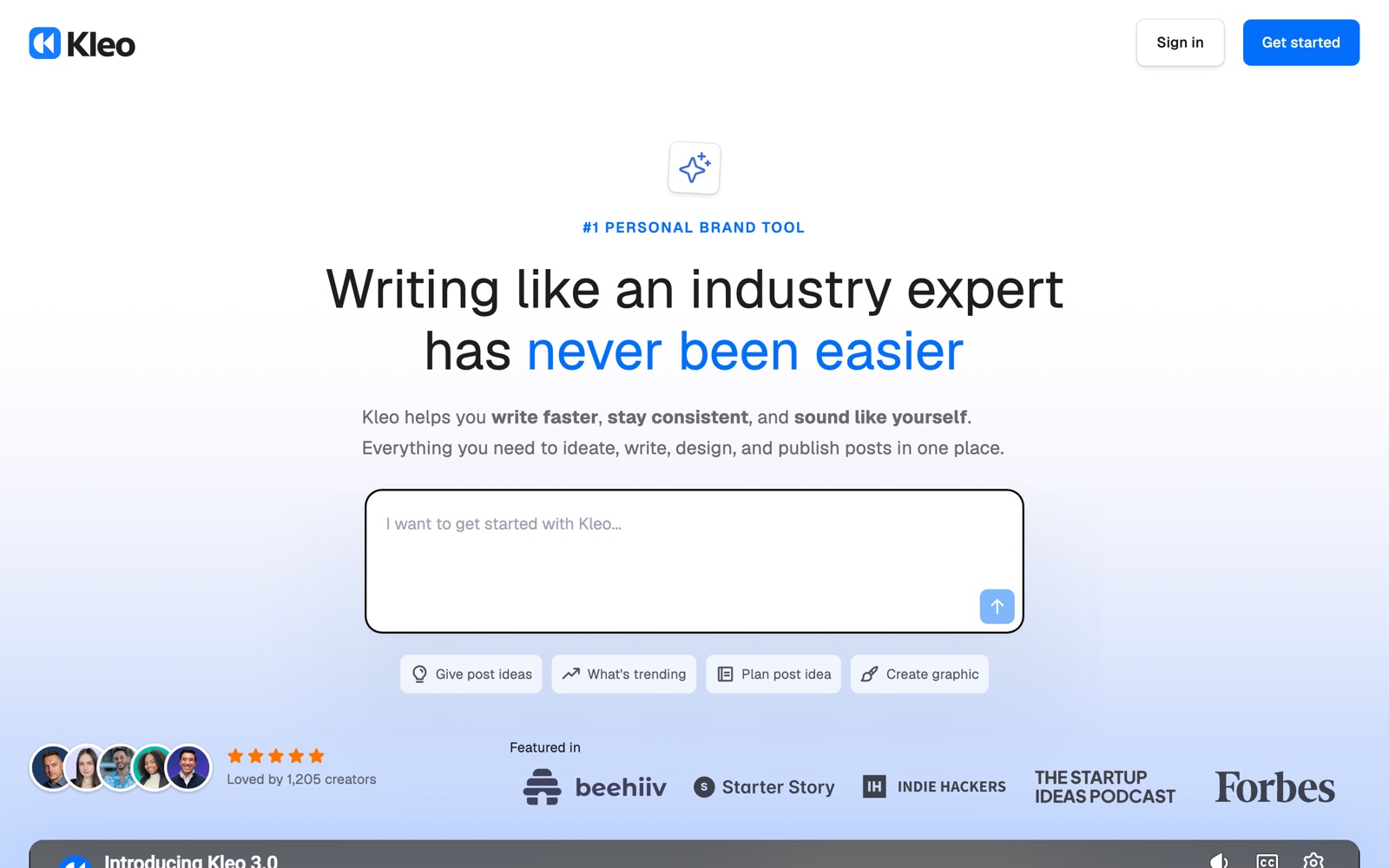
Kleo is less a software subscription and more a program. The software side gives you unlimited AI post generation, one-click graphics, 200+ hook templates, 160+ post templates, and 170+ swipes of top-performing posts. The program side is the differentiator: weekly live group coaching, LinkedIn strategy and engagement playbooks, and a private creator community.
Best for: creators who want human accountability and coaching bundled with their tool.
What you get: $99/mo on monthly billing, or $999/year (two months free). Annual buyers also get a 1:1 onboarding call, priority support, and early access to features, plus a 30-day risk-free guarantee.
The good: the template and swipe library is strong, and the weekly coaching calls are something no pure software tool offers.
The bad: it is the most expensive tool on this list, there is currently no free trial, and graphic generation is capped at 20 per month even on annual. There is no scheduling depth, no analytics suite, and no lead management: you are paying for content help and coaching, not a platform.
Pick it over Taplio if: you know you need coaching more than software. Our hands-on take: Kleo review.
4. MagicPost: lightweight AI generation
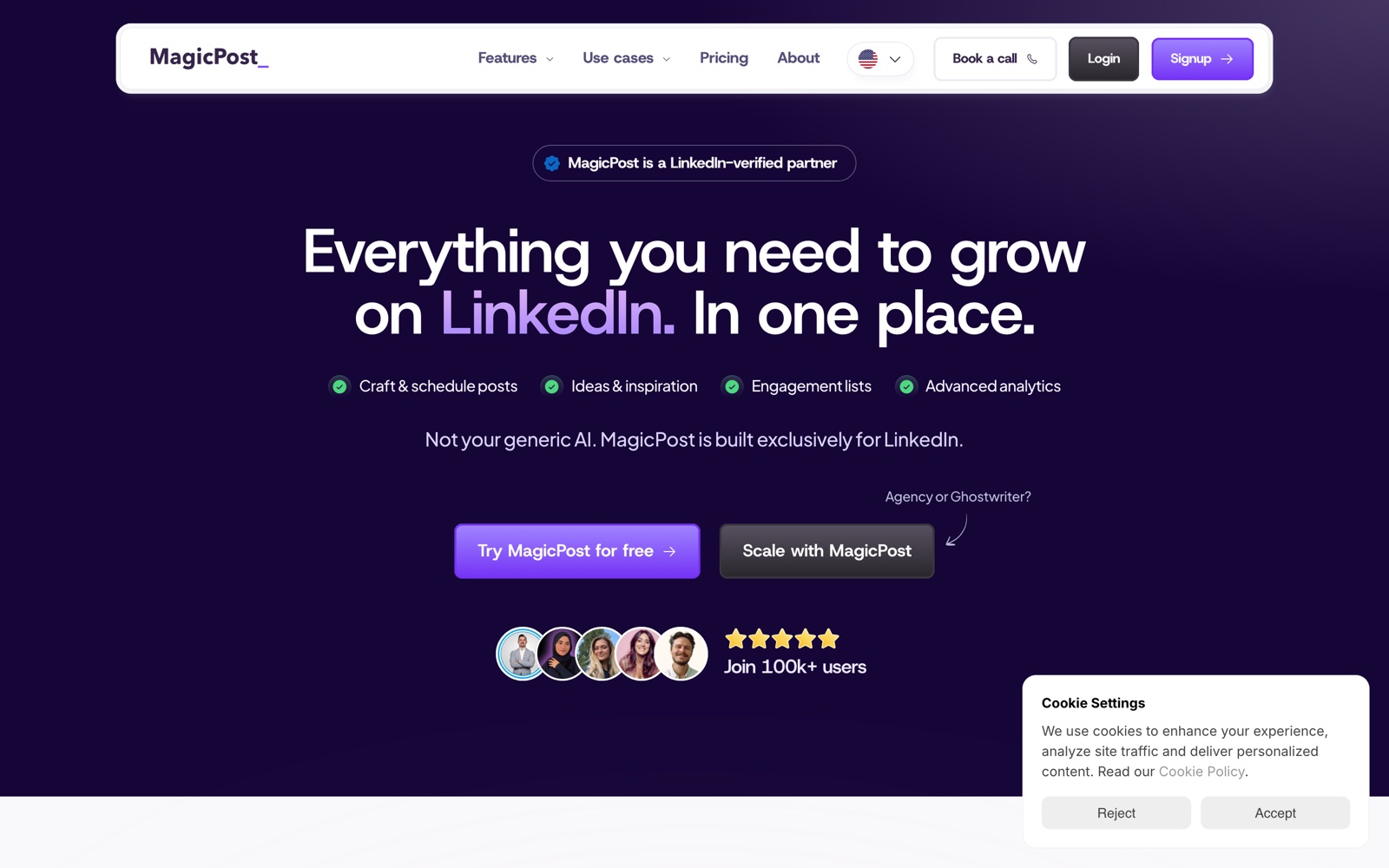
MagicPost keeps things deliberately simple: a post generator, an idea generator, an inspiration library, scheduling with comment scheduling included, and solid LinkedIn metrics, without trying to be a full growth platform.
Best for: consistent posting with minimal setup and a small bill.
What you get: the Analytics plan at $21/mo covers advanced LinkedIn metrics plus manual writing and scheduling. The Creator plan at $39/mo (their most popular) adds the AI post and idea generators, the inspiration library, engagement metrics for any creator you want to study, and an API/MCP integration. Yearly billing takes 40% off, and the trial requires no card.
The good: honest scope, low price, and one of the few small tools shipping an MCP integration.
The bad: single seat on both self-serve plans, no engagement or lead features, and team features are quote-only with a sales call.
Pick it over Taplio if: you want exactly one thing (AI drafts plus scheduling) and nothing else. See our Taplio vs MagicPost comparison and MagicPost review.
5. ContentIn: an AI ghostwriter trained on your style
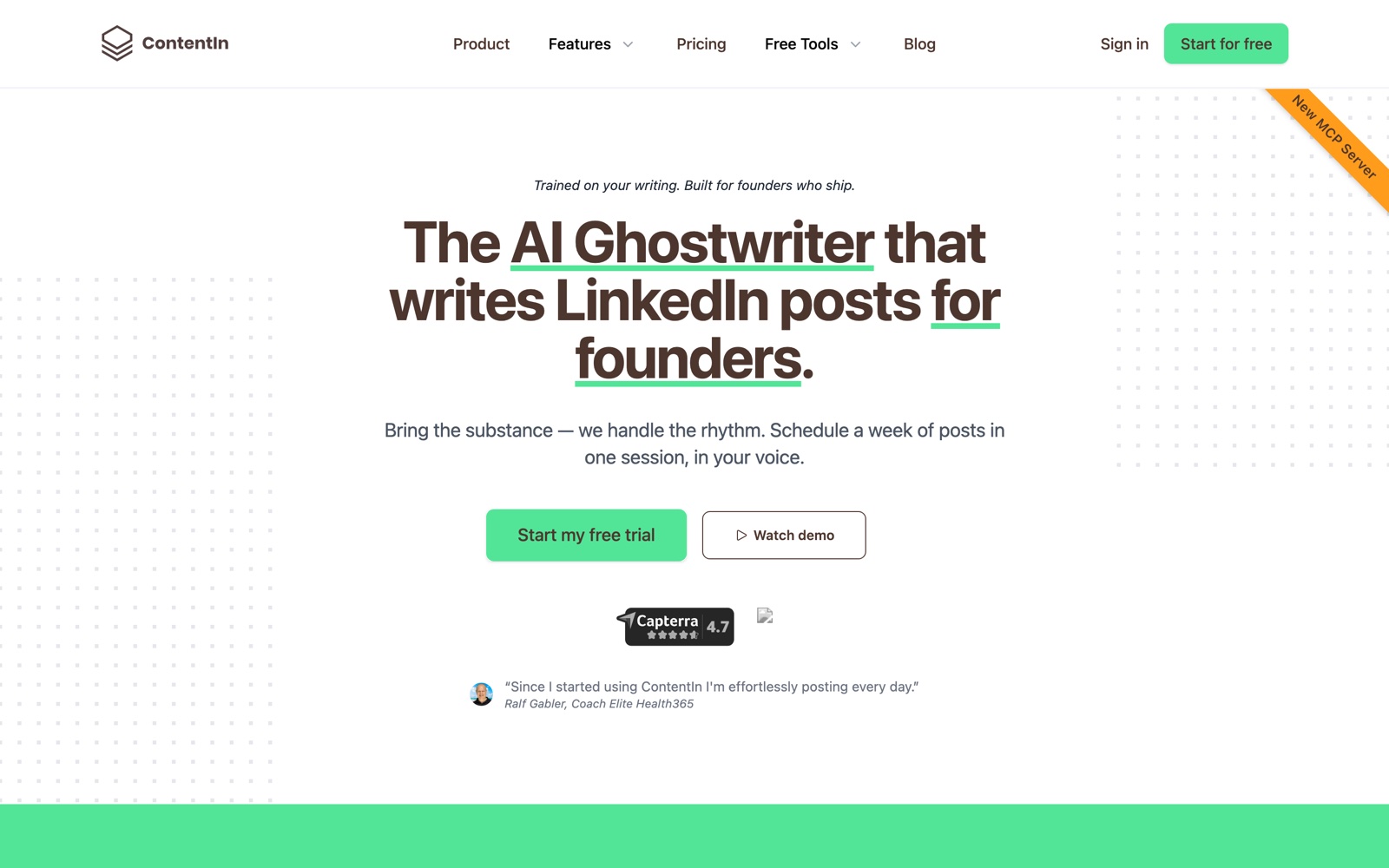
ContentIn positions itself as an AI ghostwriter for founders: it learns your writing style and drafts posts in your voice, with a content planner built around posting mix and timing rather than raw volume.
Best for: founders who want a week of posts planned in one sitting.
What you get: a genuinely free scheduler plan with a calendar view (rare in this market), and paid tiers that add the style-trained AI ghostwriter (12 drafts per month on the mid tier), AI idea generation from your own sources (up to 50 ideas per month), AI carousel creation (4 per month), and AI image and comment generation.
The good: the free plan is a real free plan, and the style-training approach produces drafts that sound less templated than raw prompting.
The bad: the AI allowances are metered tightly (drafts, ideas, carousels, and images all have monthly caps), and there is no viral content database, engagement layer, or lead features to grow into.
Pick it over Taplio if: you want a free way to start scheduling today and grow into AI later.
6. Typefully: minimalist writing across platforms
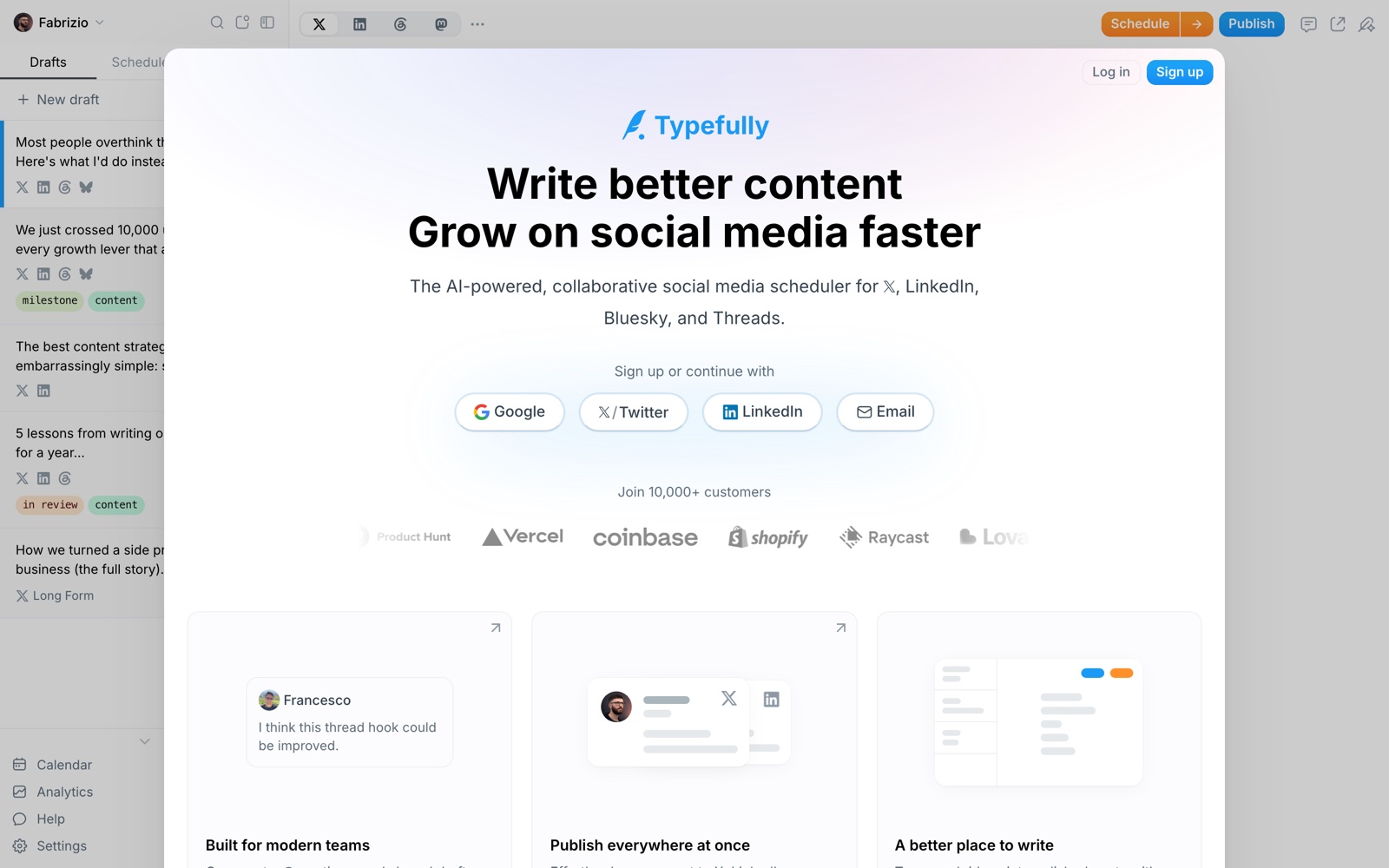
Typefully is the writer's favorite: a clean, distraction-free editor that publishes to X, LinkedIn, Threads, Bluesky, and Mastodon from one place. Creators who live in it praise exactly that simplicity, including people who tried a dozen schedulers before settling.
Best for: creators running the same content across several networks.
What you get: a free plan with 10 posts per month and a free AI writer to start, then paid plans that scale publishing limits to 1,000 and 1,500 posts per month and add deeper analytics, AI assistance, and collaboration. There is even a free API tier.
The good: the cleanest writing surface in the category and true multi-platform publishing from one draft.
The bad: LinkedIn is one channel among several, not the focus. You will not find LinkedIn-specific analytics depth, a viral LinkedIn post library, benchmark data, or lead workflows.
Pick it over Taplio if: X or Threads matter as much to you as LinkedIn does.
7. Buffer: the multi-platform budget pick
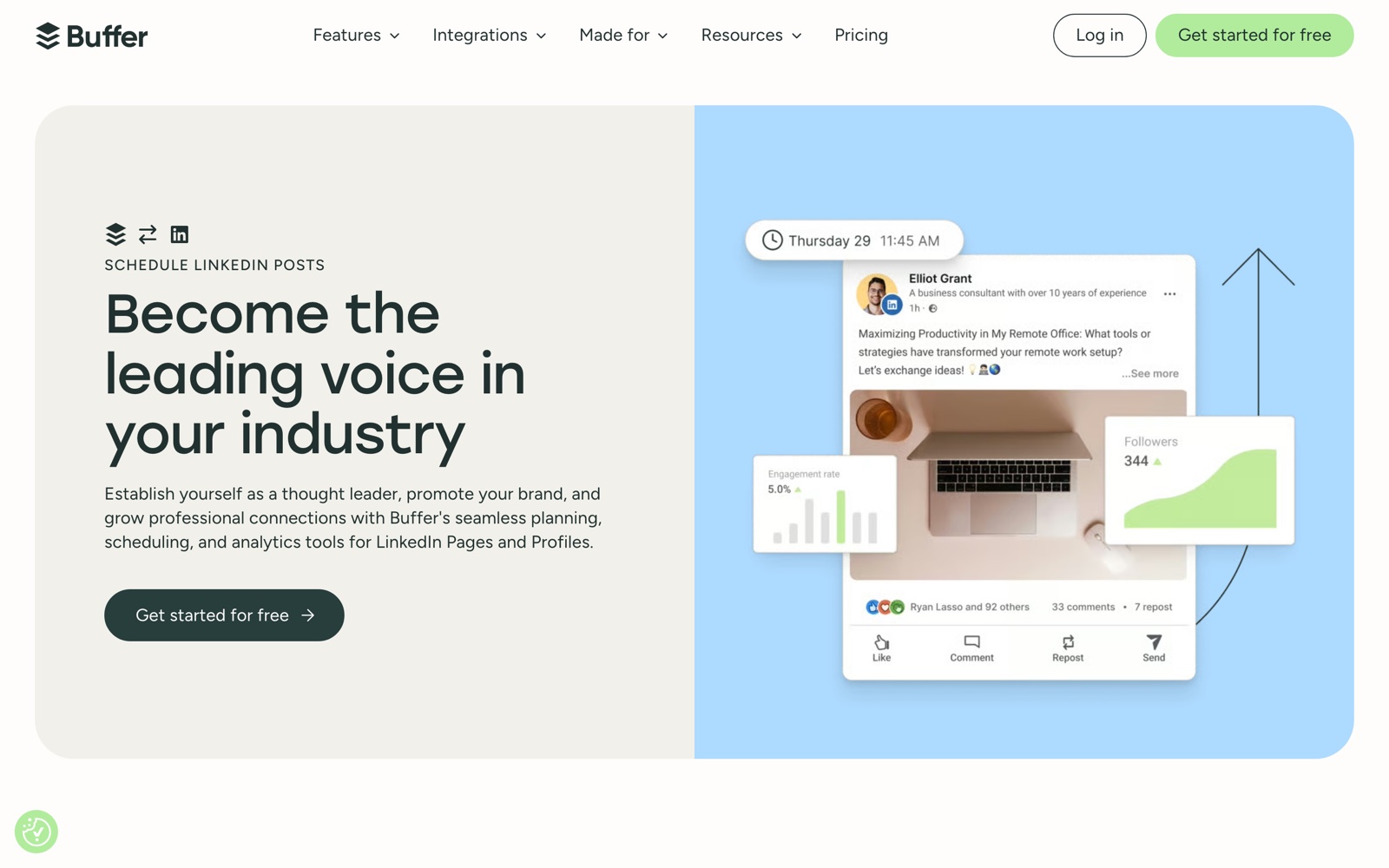
Buffer has been the default affordable scheduler for a decade, and it remains excellent at exactly that: queueing content across LinkedIn, Instagram, X, and more, including auto-publishing carousels and multi-page PDFs on LinkedIn.
Best for: anyone who needs cheap, reliable multi-platform scheduling.
What you get: the free plan covers 3 channels with 10 scheduled posts per channel, 100 ideas, and 30 days of analytics history. Essentials at $5 per channel per month (or $60 per channel per year) unlocks unlimited scheduling, full analytics, first-comment scheduling, and a hashtag manager. Team at $10 per channel adds unlimited members and approval workflows. Both paid plans have a 14-day trial.
The good: the most generous free plan here, transparent per-channel pricing, and rock-solid reliability.
The bad: Buffer is a scheduler, not a LinkedIn growth tool. No LinkedIn-specific AI writing, no viral post research, no benchmark data, no lead features, and analytics built for channels rather than personal brands.
Pick it over Taplio if: your need is scheduling across networks, full stop. If LinkedIn is your main channel, compare it against our LinkedIn post scheduler first.
8. Hootsuite: for enterprise social teams
Hootsuite plays in a different league: social listening, approval workflows, and multi-network management for organizations, priced accordingly.
Best for: marketing teams managing many brands and networks with compliance needs.
What you get: Standard at $99 per user per month (annual billing) manages up to 10 social accounts. Professional at $199 and Advanced at $399 go unlimited on accounts and add deeper workflows. Enterprise is custom. The 14-day trial needs no card, though trial accounts carry daily posting limits.
The good: nothing on this list matches its enterprise workflow depth, approvals, and multi-brand governance.
The bad: the entry ticket costs more than most tools here combined, and LinkedIn personal-brand growth is simply not what it is built for. Individual creators will pay enterprise prices for features they never open.
Pick it over Taplio if: you are a social media team first and LinkedIn creators second. More in our Taplio vs Hootsuite comparison and Hootsuite review.
What about Shield?
Shield was the reference for pure LinkedIn analytics since 2018. In 2026 the founders announced the product is winding down, stating on their official page that "both Google and LinkedIn made it clear that we could not continue operating Shield as it was built".
If you are a Shield user looking for a new home for your analytics, we wrote a dedicated migration guide: the best Shield alternatives. Spoiler: several listicles ranking above this page still recommend Shield as their top analytics pick, which tells you how often they update their content.
A word about the "I tested 10 tools" listicles
Search "Taplio alternatives" and you will find a wall of articles with near-identical titles: 7 best, 9 best, 10 best, 11 best. Here is how to read them. Check who publishes the article, then check which tool ranks first in it. In almost every case, the publisher's own product sits at number one, "tested" against a rubric it happens to win.
That does not make the articles useless: the feature lists are often accurate. It makes the rankings useless. This page has the same bias in the other direction, which is why we put our competitors' real strengths in writing and linked directly to their sites. Cross-read two or three of these pages, including ours, and the truth sits in the overlap.
One reliable freshness test: if a listicle still recommends Shield as an active product, or quotes Taplio plans that do not exist (we have seen "Solo" and "Team" plans invented out of thin air), the author has not opened the tools this year.
How to choose the right tool
Ignore the rankings (including ours) and start from your actual bottleneck:
- "I do not know what to write": you need idea generation grounded in what works. Taplio (viral post database plus AI), Supergrow, or ContentIn.
- "I write fine but post inconsistently": you need scheduling and structure. Taplio Starter, Buffer, or Typefully.
- "I want to write everything myself, better": AuthoredUp, no contest.
- "I need accountability, not features": Kleo's coaching model.
- "I manage several brands or networks": Buffer for budget, Hootsuite for enterprise.
- "I want posting to turn into pipeline": Taplio Pro is the only tool on this list with a lead layer built in.
Then run a two-tool test. Shortlist two candidates, run both trials in the same week, and batch the same five posts in each. The tool that gets you to "scheduled and confident" faster is your answer, whatever any listicle says.
Why creators stay with Taplio
Since you are on our blog, here is our case, kept short. Taplio is the only LinkedIn-first tool that covers the full loop: find ideas from a 5M+ viral post database, draft with AI, schedule, engage from a single feed, track analytics, and turn engagement into leads. The alternatives above each do one or two slices of that loop.
Two things are genuinely unique. First, every plan includes the LinkedIn Benchmark, our monthly analysis of 60,000+ LinkedIn posts that tells you what reach and engagement actually look like at your follower level. Second, Taplio ships an MCP server, which means you can pull your Taplio drafts, analytics, and inspiration directly into Claude or ChatGPT and work from there.
The honest trade-off: we cost more than the budget tools. The 7-day free trial gives you full Pro access, whichever plan you pick, and there is a 30-day money-back guarantee if you forget to cancel. Try the loop for a week and see if it earns its price.
Frequently asked questions about Taplio alternatives
What is better than Taplio?
It depends on your bottleneck. AuthoredUp is better if you refuse AI and want craft tools. Buffer is better for cheap multi-network scheduling. Kleo is better if you need live coaching. For the full LinkedIn loop (ideas, writing, scheduling, engagement, analytics, leads) in one tool, we have not found a better one, which is why we build this one.
Is Taplio banned by LinkedIn?
No. Taplio is live, thousands of creators publish through it daily, and posting and scheduling are the heart of the product. This rumor circulates mostly through competitor blog posts. As with any third-party tool, engagement automation features should be used within reasonable limits, and Taplio enforces conservative limits by default.
Is there a free Taplio alternative?
Buffer's free plan (3 channels) and Typefully's free plan (10 posts per month) are the best free schedulers. ContentIn offers a free LinkedIn-only scheduler. Taplio also ships free tools (post generator, carousel maker, post formatter) plus a 7-day trial with full Pro access, no strings attached.
Does Taplio's $39 plan include AI writing?
No, and we would rather tell you here than let you find out after subscribing. Starter ($39/mo, or $32/mo billed annually) covers scheduling, analytics, and consistency features. AI writing starts with Growth at $69/mo ($49/mo billed annually), and Pro ($199/mo) removes AI limits and adds lead outreach.
Is Supergrow better than Taplio?
Supergrow is better on entry price ($19 vs $39) and includes AI from the first plan. Taplio is better on research (the 5M+ post database), analytics context (the Benchmark), engagement workflows, and lead features. Cheaper tool for writing, deeper platform for growth: the full comparison maps it feature by feature.
What is the best Taplio alternative for teams?
For LinkedIn-focused teams, Supergrow Teams ($139/mo for 4 accounts) or AuthoredUp Business ($14.95 per profile) are solid. For full social media operations, Hootsuite. Taplio's Growth and Pro plans include team collaboration if you want to stay on one platform.
What is the best Taplio alternative for ghostwriters and agencies?
AuthoredUp Business handles multiple client profiles cleanly at $14.95 per profile. Hootsuite fits agencies already managing every network. If your agency runs LinkedIn growth end to end (content plus engagement plus reporting), Taplio's team features on Growth and Pro keep all clients in one workflow.
What happened to Shield Analytics?
Shield announced in 2026 that it is winding down after Google and LinkedIn made continuing impossible in its current form. Export your data while you can, and see our Shield alternatives guide for migration options.
The bottom line
There are more good LinkedIn tools in 2026 than ever, and most of the articles ranking for "Taplio alternatives" are sales pages wearing a listicle costume. Our advice is simple: identify your real bottleneck, shortlist two tools from this page, and run both trials in the same week on the same content.
If your bottleneck is the whole loop rather than one slice of it, start your 7-day Taplio trial. You get full Pro access, and if it does not change how you show up on LinkedIn, one of the eight tools above will be waiting.


Keep reading
All articlesRelated Articles



.avif)
Your Linkedin AI coach is waiting for you
Join 12,000+ creators who let their coach turn the blank page into a plan and watch their audience compound.
7-day free trial · 30 day money back · Cancel anytime
AVG. VIEWS
2,979
-1.5%
ENGAGEMENT
3.2%
+0.8%

Free Monthly Report
How does your LinkedIn compare?
Get free monthly benchmarks on reach, engagement, and content format performance.
Get the Benchmark