
Pricing


AI writer

Taplio
MCP V2
New: Engage tools
Taplio MCP V2 now available, try it out
Your AI can now comment and reply for you. It finds the posts worth engaging, drafts in your voice and queues them on your Taplio account. Nothing posts until you confirm.

How to See Who Viewed Your LinkedIn Profile (2026 Guide)

August 18, 2026

10
min read

 Open in ChatGPT
 Open in Claude
 Open in Perplexity
Key Takeaways
- LinkedIn profile viewers: A free LinkedIn account shows the viewer count for the last 90 days and names only the 3 most recent visitors, while anyone browsing in private mode appears as "LinkedIn Member" no matter which plan is paid for.
- Exact path: On desktop click the Me icon, select View profile, scroll to the Analytics block under the profile header and click Profile viewers, or use the "Who's viewed your profile" link in the home page left sidebar; on mobile tap the profile picture, View profile, Analytics, Profile viewers.
- The number that decides: LinkedIn's lookback window is 90 days on a free account versus 365 days on Premium, and views older than that window are removed and cannot be recovered.
- Check before upgrading: Confirm the plan window, whether your own "Visibility when viewing other profiles" is set to name and headline, since LinkedIn warns that private mode or private profile characteristics disables Who's Viewed Your Profile and erases viewer history on free accounts, and remember logged-out visits never register.
- Decision rule: Stay free if the 3 most recent names are enough, take Premium if the 365-day window, full list and company or title filters matter, and fix a short list by posting two or three times a week; Taplio can schedule and track that posting from $39/month with a 7-day trial and no free plan.
Someone looked at your profile. LinkedIn tells you that much, and then it gets vague about the rest.
How much you actually see depends on two things: the plan you are on, and the privacy setting the visitor chose before they clicked. This guide covers what LinkedIn shows in each case, how to read the list, how private mode works on both sides of it, and how to get more of the right people looking at your profile in the first place.
Can you see who viewed your LinkedIn profile?
Yes, partly. LinkedIn logs every profile view and shows you a list under "Who's viewed your profile", but it only names the visitors who allowed themselves to be named.
Everyone else shows up as an anonymous entry, or as a vague description like "Consultant in the insurance industry". That is not a bug or a limit of your plan. It is the visitor's own setting, and nothing you subscribe to will override it.
What LinkedIn shows you: free account vs Premium
The plan changes how far back you can look and how many names you get, not whether anonymous viewers become visible.
| Free account | Premium | |
|---|---|---|
| Viewer count | Last 90 days | Last 365 days |
| Named viewers | The 3 most recent, when they allow it | Full list, when they allow it |
| Filters | None | By company, job title, industry, location |
| Trends over time | No | Weekly graph and demographic breakdown |
| Anonymous viewers | Stay anonymous | Stay anonymous |
The last row is the one people get wrong. Upgrading extends your window and unlocks filters. It does not unmask anyone who chose to browse privately. If your only reason for upgrading is to find out who that anonymous viewer was, Premium will not do it.
One more catch that costs people their list without warning: if you browse in private mode yourself, LinkedIn removes your access to your own viewer list on a free account. You trade one for the other.
How to see who viewed your profile, step by step
On desktop
- Click the Me icon in the top navigation bar.
- Select View profile.
- Scroll to the Analytics block, just under your profile header.
- Click Profile viewers to open the full list.
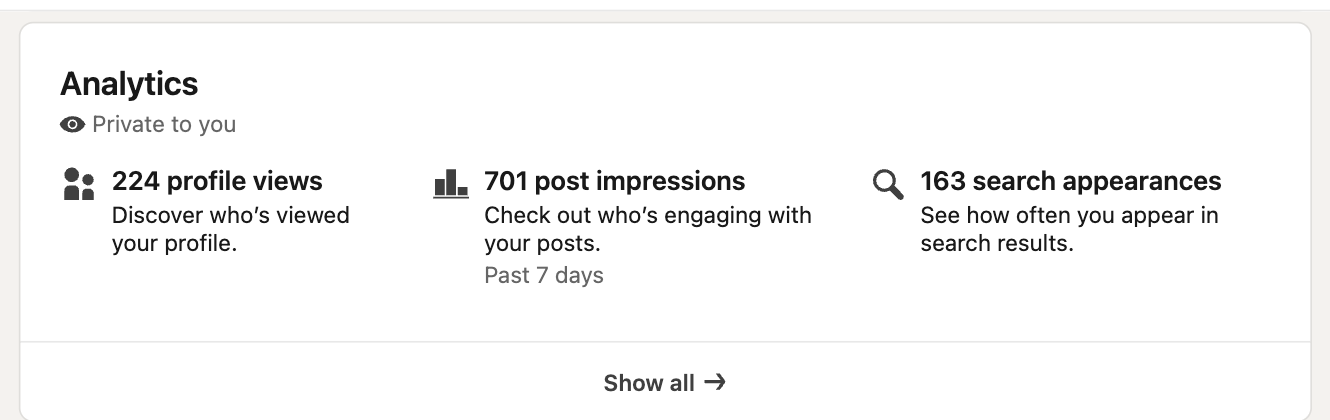
There is a faster route from the home page. The "Who's viewed your profile" line sits in the left sidebar under your name, and it takes you to the same place in one click.
On the mobile app
- Tap your profile picture, top left.
- Tap View profile.
- Scroll to Analytics.
- Tap Profile viewers.
The mobile list carries the same data as desktop. What mobile does not give you is the sidebar shortcut, so you go through your profile every time.
What information you can see about each viewer
Every LinkedIn member picks one of three viewing modes, and that choice decides what lands in your list. LinkedIn calls the setting "Visibility when viewing other profiles", and it governs LinkedIn profile viewing in both directions: what you reveal when you browse, and what you get to see when others browse you.
| Their setting | What you see |
|---|---|
| Your name and headline | Full name, headline, profile photo, connection degree. You can click through and connect. |
| Private profile characteristics | Job title, company, school or industry, with no name. Something like "Head of Sales at a software company". |
| Private mode | "LinkedIn Member - This person is viewing profiles in private mode". Nothing else. |
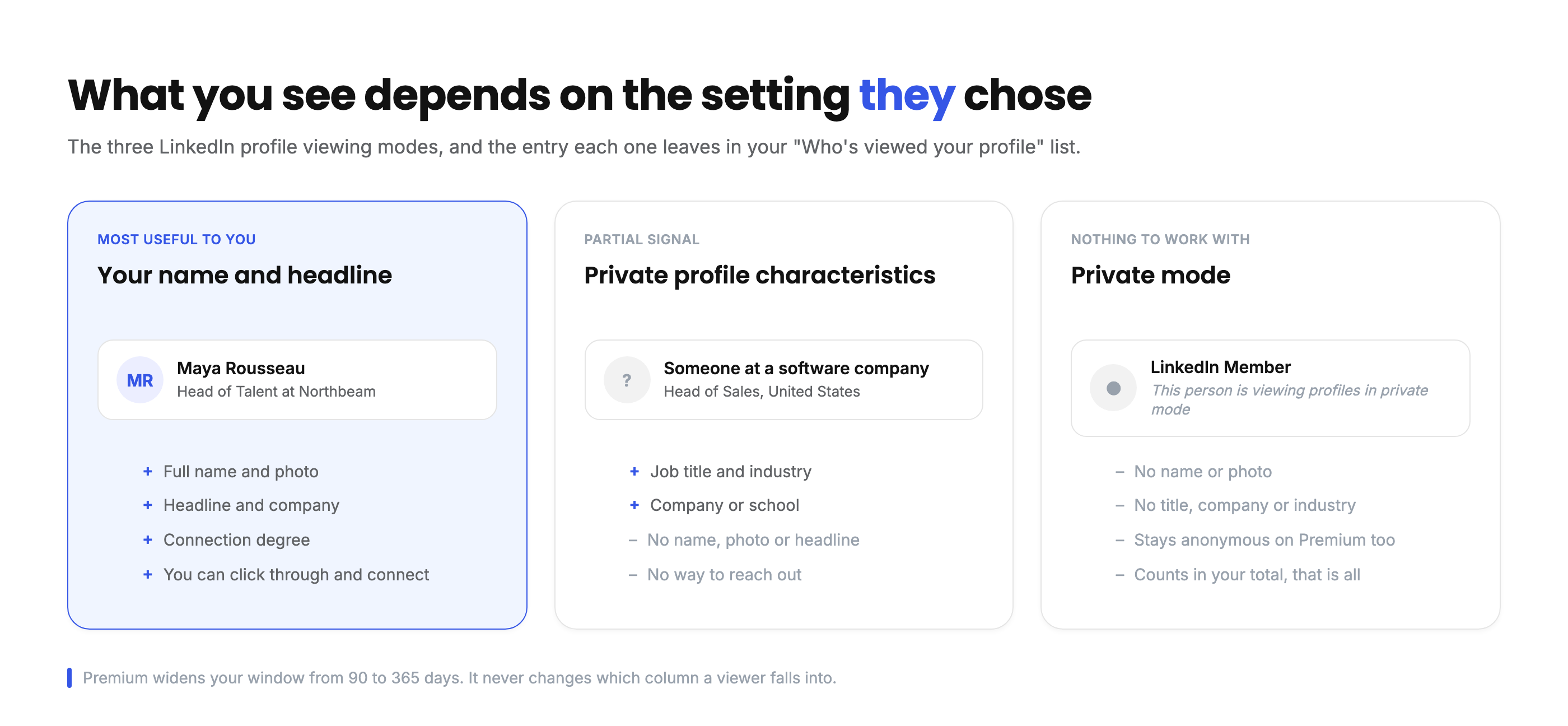
A practical read on the middle row: semi-private entries are still useful. A viewer described as "Recruiter in financial services" tells you your profile is reaching the right desk, even without a name attached.
Why you can't see some viewers
Four reasons cover almost every case.
- The visitor browses in private mode. The most common one. Recruiters and salespeople often keep it on permanently.
- You browse privately yourself. This catches more people than it should, because it is not only full private mode. LinkedIn's own warning on the settings screen is explicit: selecting either private profile characteristics or private mode disables Who's Viewed Your Profile and erases your viewer history. Semi-private counts. On a free account the list is gone; Premium keeps the last 90 days.
- The view is older than your window. Ninety days on free, 365 on Premium. Past that, the entry is gone.
- The person was logged out. A profile opened without a LinkedIn session does not register as a view at all, so it never reaches your list.
That last point answers a question people ask a lot: what actually triggers a profile view. Opening someone's profile page while signed in is what counts. Seeing their name in a feed, in search results or in a comment thread does not.
LinkedIn private mode: how it works and when to use it
Private mode is the same setting seen from the other side. It lets you open any profile without the owner learning who you are. It is free, it takes three clicks, and there is no cap on how many profiles you can look at, beyond LinkedIn's general limits on heavy browsing.
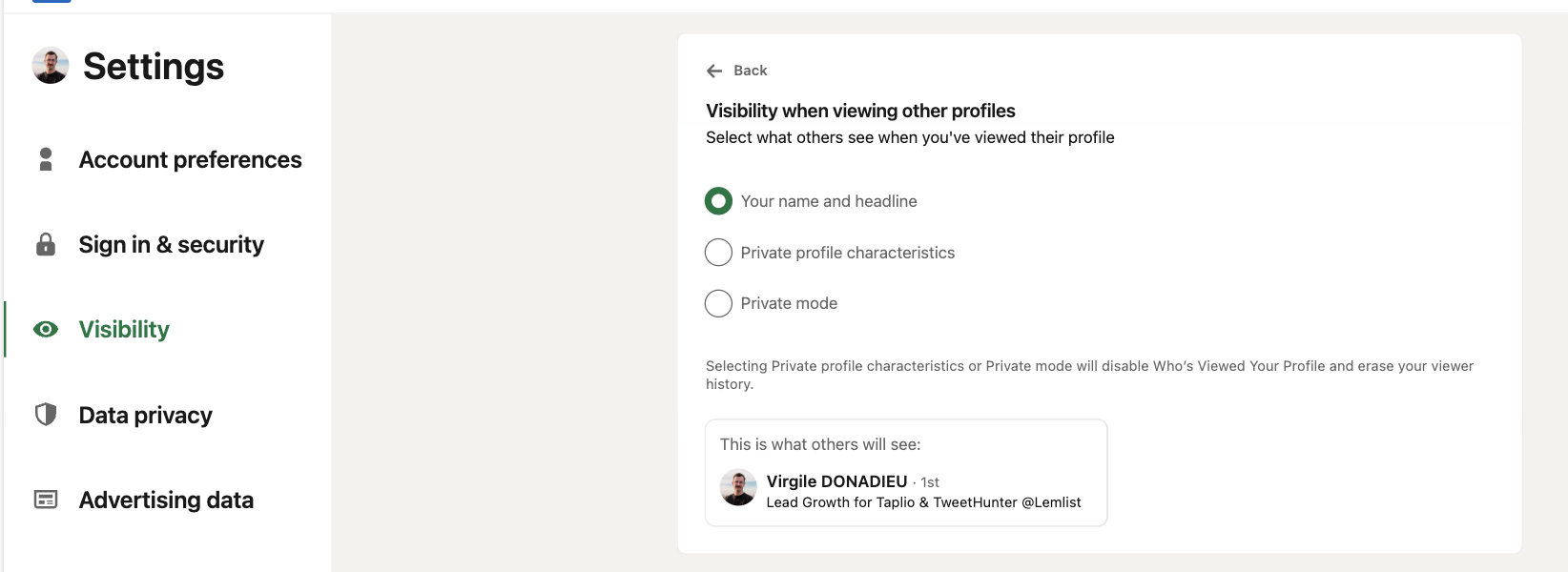
One warning before you switch: LinkedIn states on the settings screen that choosing private profile characteristics or private mode will disable Who's Viewed Your Profile and erase your viewer history. The history does not come back when you switch the setting off, so if there is anything in your current list you want, look at it first.
How to turn on private mode on desktop
- Click the Me icon, then Settings & Privacy.
- Open Visibility in the left rail.
- Under Visibility of your profile & network, click Visibility when viewing other profiles.
- Select Private mode.
How to turn on private mode on mobile
- Tap your profile picture, then Settings.
- Open Visibility.
- Tap Visibility when viewing other profiles.
- Select Private mode.
The change applies immediately and retroactively to nothing. Profiles you viewed before flipping the switch keep the identity you had at the time.
Four things private mode is genuinely good for
Researching how others position themselves. If you are rebuilding your profile, you will want to open twenty profiles in your field and study how they write their headline and About section. Doing that under your own name looks odd. Profile research is the cleanest use case there is.
Watching competitors. You can read a competitor's profile, see which roles they are hiring for and check who engages with their content, without announcing that you are paying attention.
Reading up on a prospect before you reach out. This one has a real cost attached. A prospect who sees you viewed their profile four times before your first message will read that message differently. Private mode removes the awkwardness, then you write the connection message on your own terms.
Screening candidates. Opening a shortlist of candidate profiles under a hiring manager's name creates expectations you may not want to set before you have decided anything.
What private mode costs you
Two real drawbacks, and both matter more than people expect.
You lose your own viewer list on a free account. That is the direct trade. And you lose the reciprocal traffic: a good share of profile views come from people who got a notification that you looked at them and looked back. Turn on private mode and that loop stops. If you are actively networking or job hunting, that quiet stream of return visits is worth more than the anonymity.
Private mode with Premium
Premium is the one way to have both. You browse in private mode and still see your own viewers for the last 90 days. The people who viewed you in private mode stay anonymous either way, so the upgrade buys you your list back, not their identity.
How to view a LinkedIn profile anonymously
Private mode is the built-in answer, and for most people it is the right one. There are two alternatives worth knowing.
Log out and open the public profile. A signed-out visit registers nothing, so the profile owner never sees it. You only get the public version of the profile, which is usually the headline, the About section, current role and public posts. It is enough for a quick check and it answers the "can I view LinkedIn as a guest" question: yes, for public profiles only.
Use a profile viewer tool. Free tools pull the same public data through LinkedIn's public pages, without an account and without leaving a trace. They cannot show anything the person has not made public, so treat any tool promising access to private profiles as a red flag.
Using a LinkedIn viewer without login
This is the category most people mean when they search for a LinkedIn viewer. A handful of free web tools let you paste a profile URL and read the public data back without signing in to anything: name, headline, photo, location, follower count, the About section and recent public posts.
They work because that data is already public. LinkedIn serves it to search engines, and the tool reads the same page you would get by opening the profile in a private browser window. What that means in practice: the tool is a convenience layer, not a workaround. Viewing profiles on LinkedIn through a third-party viewer shows you exactly what logging out would show you, in a cleaner format and without the sign-in prompt LinkedIn throws at anonymous visitors after a few pages.
Two things to check before you trust one. It should never ask for your LinkedIn credentials, and it should be upfront that private profiles return nothing. Any tool advertising access to profile viewing data that LinkedIn keeps behind Premium, or to profiles set to private, is either scraping in breach of LinkedIn's terms or simply lying about what it does.
Whichever route you take, the limit is identical: no method reveals data the member has chosen to hide, and no method lets you see who viewed you if you are browsing privately on a free plan.
How to get more profile views
Most people try to squeeze more out of the viewer list when the real problem is that the list is short. Profile views are downstream of visibility, and visibility on LinkedIn comes from posting.
The mechanism is simple. Someone reads your post in the feed, the post is good, they tap your name to find out who wrote it. That tap is your profile view. No posting, no taps.
Three things move the number, in order of impact:
- Post consistently. Two or three posts a week beats a burst of ten followed by silence. Cadence matters more than volume.
- Comment where your audience already is. A sharp comment on a post with 500 readers puts your name in front of 500 people, which is often more reach than your own post gets early on.
- Make the profile worth the click. A vague headline converts a curious reader into nothing. The headline is what they read before deciding whether to open your profile at all.
If you want to know what a healthy number looks like for an account your size before you set a target, the LinkedIn benchmark has the medians by follower bracket. And once you are posting regularly, tracking profile views alongside your post performance is what turns the list into a signal rather than a curiosity.
One last thing worth doing before any of this: look at your own profile the way a visitor sees it. Half the profiles I open have something broken in the first screen that the owner has never noticed.
Frequently asked questions
Can I see who viewed my LinkedIn profile without paying?
Yes. You can see who viewed your profile on LinkedIn without Premium, within limits. A free account shows the number of viewers over the last 90 days and names the 3 most recent, provided those people browse with their name and headline visible. Premium extends the window to 365 days and shows the full list, but it never reveals viewers who browsed in private mode.
Can I view someone on LinkedIn without them knowing?
Yes, by setting your profile viewing option to private mode. The person still gets a notification that someone viewed their profile, but it reads "LinkedIn Member - This person is viewing profiles in private mode" with no name, photo or job title attached.
Can I view LinkedIn profiles without an account?
You can view the public version of a profile without an account, which usually includes the name, headline, About section, current role and public posts. Anything the member restricted to signed-in users or to their network stays hidden.
Can I view LinkedIn as a guest?
Yes. Opening a profile while logged out shows the public profile and registers no view, so the owner never learns you were there. The trade-off is that you only see what the member made public.
How can I view LinkedIn profiles anonymously?
Three options: turn on private mode in your visibility settings, log out and open the public profile, or use a free profile viewer tool that reads public data. None of them expose information the member has chosen to keep private.
What triggers a profile view on LinkedIn?
Opening someone's profile page while signed in. Seeing their name in the feed, in search results, in a comment or in a notification does not count. Only the profile page itself registers.
Why can't I see who viewed my profile on LinkedIn?
Usually one of two reasons. Either your visitors browse in private mode, which hides their identity from everyone regardless of your plan, or you have private mode switched on yourself, which removes your access to the viewer list on a free account.
Will someone know if I view their LinkedIn profile without logging in?
No. A signed-out visit is not recorded as a profile view, so it never appears in their list and triggers no notification.
How far back can I go to see who viewed my profile?
Ninety days on a free account, up to 365 days on Premium. Views older than your window are removed from the list and cannot be recovered.
Can I use private mode and still see my profile viewers?
Only with Premium. On a free account, switching to either private profile characteristics or private mode disables Who's Viewed Your Profile and erases your existing viewer history. Premium lets you browse in private mode and keep access to your viewers from the last 90 days, though private mode viewers of your own profile stay anonymous either way.


Keep reading
All articlesRelated Articles
.avif)
Your Linkedin AI coach is waiting for you
Join 12,000+ creators who let their coach turn the blank page into a plan and watch their audience compound.
7-day free trial · 30 day money back · Cancel anytime