
Pricing


AI writer

Taplio
MCP V2
New: Engage tools
Taplio MCP V2 now available, try it out
Your AI can now comment and reply for you. It finds the posts worth engaging, drafts in your voice and queues them on your Taplio account. Nothing posts until you confirm.

B2B content strategy for LinkedIn: a one-page plan


14
min read

 Open in ChatGPT
 Open in Claude
 Open in Perplexity

Key Takeaways
- B2B marketing content strategy on LinkedIn: a written plan with 6 decisions (audience, 3 to 4 pillars, voices, cadence, next step, measurement) that fits on one page, built around the 95:5 rule that 95% of B2B buyers are out of market at any time.
- The mechanism: assign one named voice to each pillar (founder for point of view, reps for teardowns, customers for proof, company page for recaps), then publish one pillar per day for 5 days with a 15-minute daily comment slot.
- The number that decides: 75% of decision-makers say thought leadership made them research products or services they had not been considering, according to the Edelman and LinkedIn study reported by Ragan in March 2024.
- The criteria: check that every pillar has a buyer problem, a named owner with a weekly time budget, one metric, and a review date before the first post goes out.
- The decision rule: choose a company-page-led plan if one marketer owns it, and a multi-voice plan if founders and reps can give 30 to 45 minutes a week, tracked in a team tool such as Taplio, from $39/month with a 7-day free trial and no free plan.
A B2B content strategy for LinkedIn is a written plan that decides who you reach, what you publish, who speaks for the company and how you measure it. About 95% of B2B buyers are out of market at any time, so the plan should earn memory first and demand second. This guide gives you the six decisions, three formats built as real posts, a one-page template and the metrics to track.
If you need definitions and content types first, start with the B2B content marketing guide for LinkedIn. This page covers the strategy layer on top of it.
Start with the buyers who are not buying yet
Most of your LinkedIn audience is not ready to buy, so a B2B strategy that only pushes offers speaks to about 5% of the room. The 95:5 rule, based on research by Professor John Dawes of the Ehrenberg-Bass Institute, says only 5% of B2B buyers are in market right now, so 95% will not buy for months or even years. The job of content is to make every one of them remember you when they enter the market.
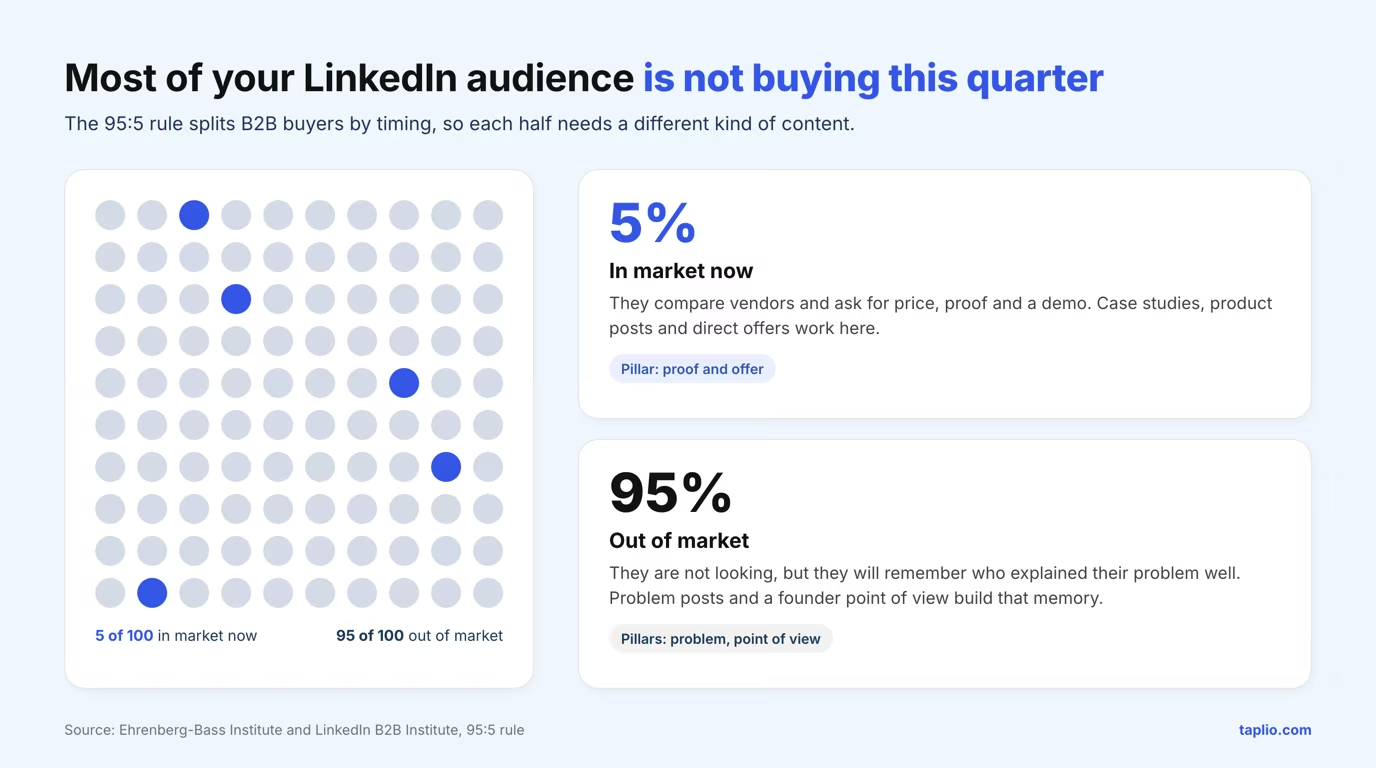
Memory has a measurable payoff. In the Edelman and LinkedIn B2B thought leadership study, reported by Ragan in March 2024, 75% of decision-makers said thought leadership had prompted them to research products or services they had not been considering. Among C-suite executives, 70% said it made them reconsider their current vendor.
Three consequences follow for the plan:
- Write for the buying group, not one persona. A deal involves a budget owner, a day-to-day user and a technical reviewer.
- Spend most posts on problems and opinions, and keep direct offers for a minority of posts.
- Judge success by who engages, not by total reach. A post that 20 target accounts comment on beats one that 20,000 strangers like.
Finding the buying group takes one hour with sales data. List the last 10 won deals, then write down every role that joined a call, from the first demo to the signature. The roles that appear in most deals are your audience, and each one becomes a reader you write for.
- Budget owner. Cares about cost, risk and proof that peers use the product.
- Daily user. Cares about time saved and how hard the switch is.
- Technical reviewer. Cares about security, integrations and data handling.
Write the role names on a sticky note next to your desk. Every draft should answer a question one of those three would ask.
Choose three or four content pillars
A content pillar is a recurring topic with a fixed job in the buying process, and three or four are enough for a B2B team. More pillars dilute the message, and fewer leave the 95% with nothing to remember. Each pillar needs a buyer problem, a funnel job and one metric.
The table maps four pillars that cover both halves of the 95:5 split.
| Pillar | Job | Buyer stage | Metric to watch |
|---|---|---|---|
| Problem | Name a cost the buyer already feels | Out of market | Comments from target roles |
| Point of view | Take a stand on how the problem should be solved | Out of market | Follows from target accounts |
| Proof | Show a customer result with a number | In market | Profile views, inbound DMs |
| Offer | Invite the next step: a resource, a call, a demo | In market | Clicks and demo requests |
Test each pillar with one question: could a competitor publish the same post? If the answer is yes, the pillar is generic. A strong pillar combines a buyer problem with something only your team knows, such as your sales calls, your support data or your customers' results.
Name each pillar after the buyer's problem, not your product. "Invoice approvals that stall" is a pillar. "Our workflow module" is a feature list.
Write a short brief for each pillar before the first post. A brief has three lines: the buyer problem in the buyer's words, the opinion you hold about it, and the proof you can show. If you cannot write the third line, the pillar is not ready, because a point of view without proof reads as opinion for its own sake.
Check each pillar against sales data before you commit. Pull the last 20 lost deals and the last 20 won deals, then list the objections and questions that repeat. The pillars that match those lists are the ones buyers already care about.
Assign one voice to each pillar
A B2B company page rarely carries a strategy alone, so decide which person speaks for each pillar. People get more attention than logos on LinkedIn, and a buying group trusts a founder or a rep who answers a real question faster than a brand announcement. Voice assignment is the step most B2B content plans skip.
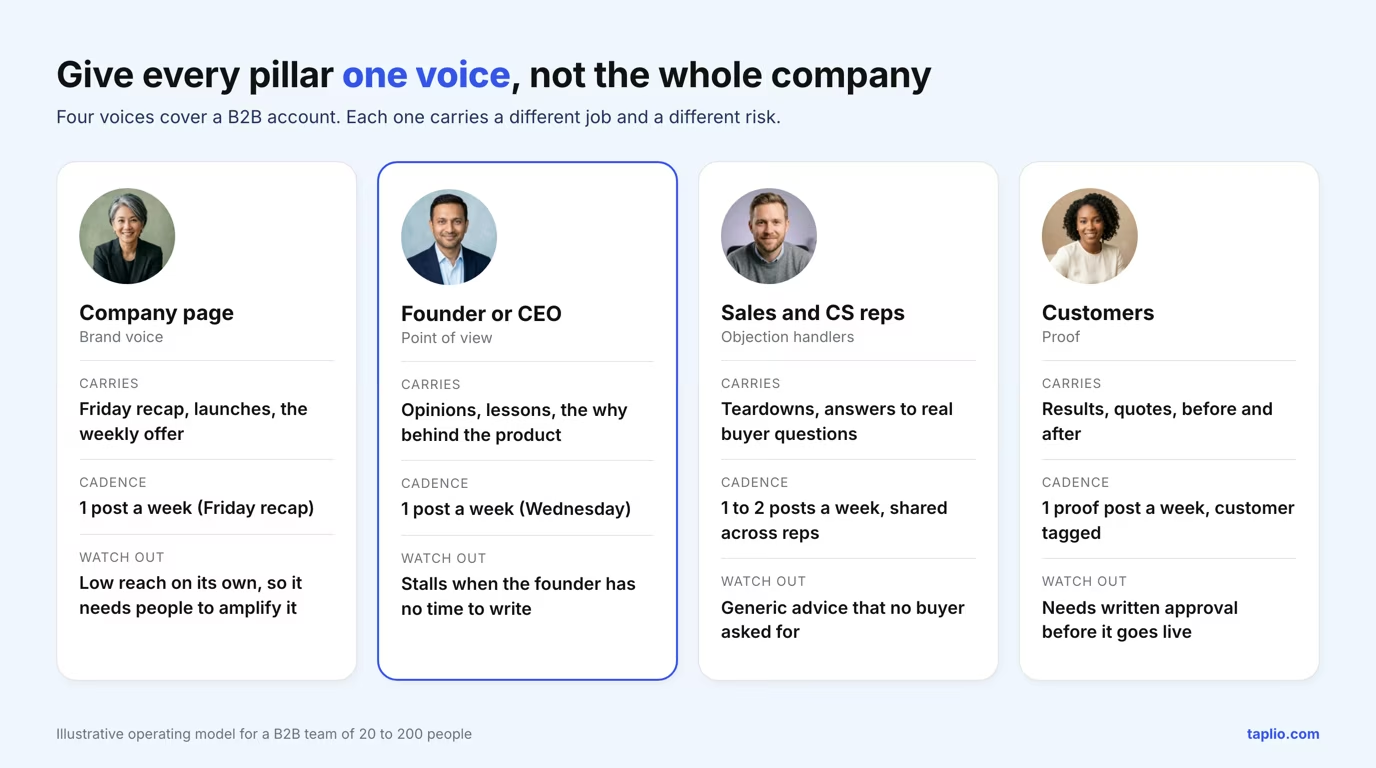
Map the voices to the pillars before the first post goes out. The founder owns point of view, reps own problem and teardown posts, customers own proof, and the company page owns offers and recaps. Each owner needs a time budget, or the plan stalls in week three.
| Voice | Owner | Weekly time (planning assumption) | Sign-off |
|---|---|---|---|
| Company page | Content marketer | 2 hours | Marketing lead |
| Founder or CEO | Founder with an editor | 45 minutes | Founder |
| Sales and CS reps | Each rep | 30 minutes | Rep, with a legal check on claims |
| Customers | Account manager | 20 minutes | Written customer approval |
Give reps three guardrails so their posts help sales instead of creating risk:
- Never name a customer or a price without written approval.
- Answer a question a buyer actually asked, in the buyer's words.
- Keep one rule for competitors: describe the problem, never attack a named company.
Teams that publish through several voices need shared scheduling, approval roles and one analytics view. Taplio for B2B teams covers team calendars and account-level analytics, and its Growth plan at $69 a month includes team collaboration. For the wider program around reps and executives, read how to run an employee advocacy program.
Set a weekly cadence you can keep
A B2B team should publish five posts a week at most, one pillar per post, and add a short daily comment slot. This is a planning default, not a benchmark: the right number is the one your owners can sustain for 90 days. A cadence that collapses in week four teaches the audience to ignore you.
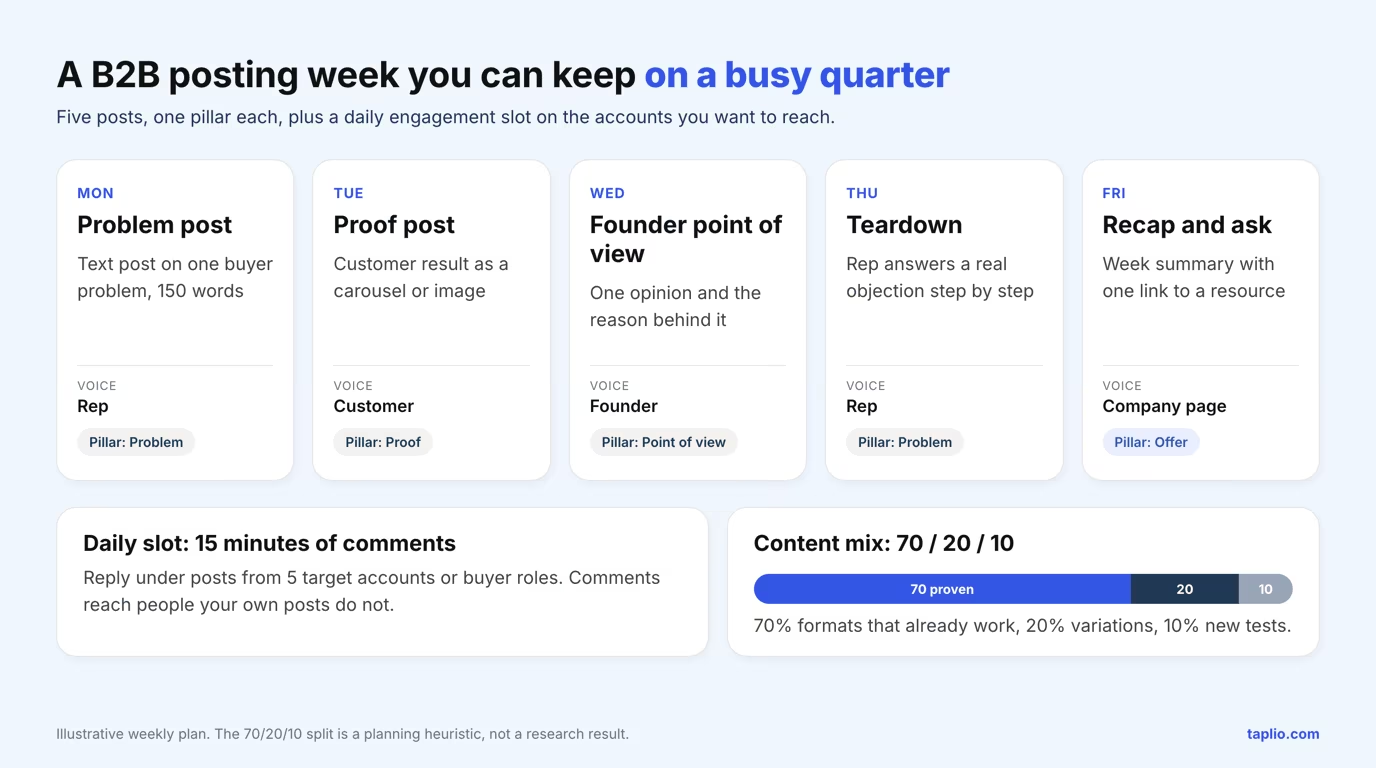
The rhythm in the figure works in three steps:
- Batch the writing. Each owner drafts their posts in one 30 to 45 minute session, then schedules them for the week.
- Protect the comment slot. Spend 15 minutes a day replying under posts from five target accounts or buyer roles.
- Review on Friday. Look at which posts drew comments from target roles, then repeat the best format.
Keep the 70/20/10 split as a guardrail: 70% proven formats, 20% variations and 10% new tests. It is a heuristic, so replace it with your own numbers after a quarter of data.
Plan for the week that breaks. A product launch, a holiday or a busy sales quarter will remove two posts from the calendar. Decide in advance which two pillars you drop first, and keep the Wednesday founder post and the daily comment slot, because they cost the least and reach the most.
Turn comments into pipeline
Comments become pipeline when every engaged account has an owner and a reply rule. A B2B strategy that stops at publishing leaves the warmest signals unused, because the people who comment on a post have already told you the topic matters to them.
Run the same five steps every week:
- Capture. List everyone from a target account who commented on or reacted to a post this week.
- Reply. Answer every comment within 24 hours with a real answer, not a thumbs up.
- Connect. Send a connection request to the commenters who fit the buying group, with a note that names the post.
- Hand off. Send the list to sales on Friday, with the post each person engaged with.
- Follow up. Sales opens the conversation with the topic of the post, never with a pitch.
This loop is what separates a content strategy from a posting habit. It gives the 95% a reason to move into the 5% on their own timing, and it gives sales a warm reason to write.
B2B content strategy examples on LinkedIn
Three post formats carry most B2B strategies: the founder opinion, the data post and the rep teardown. The three posts in this section are illustrative, written for a fictional B2B software company, and each one demonstrates one pattern you can copy.
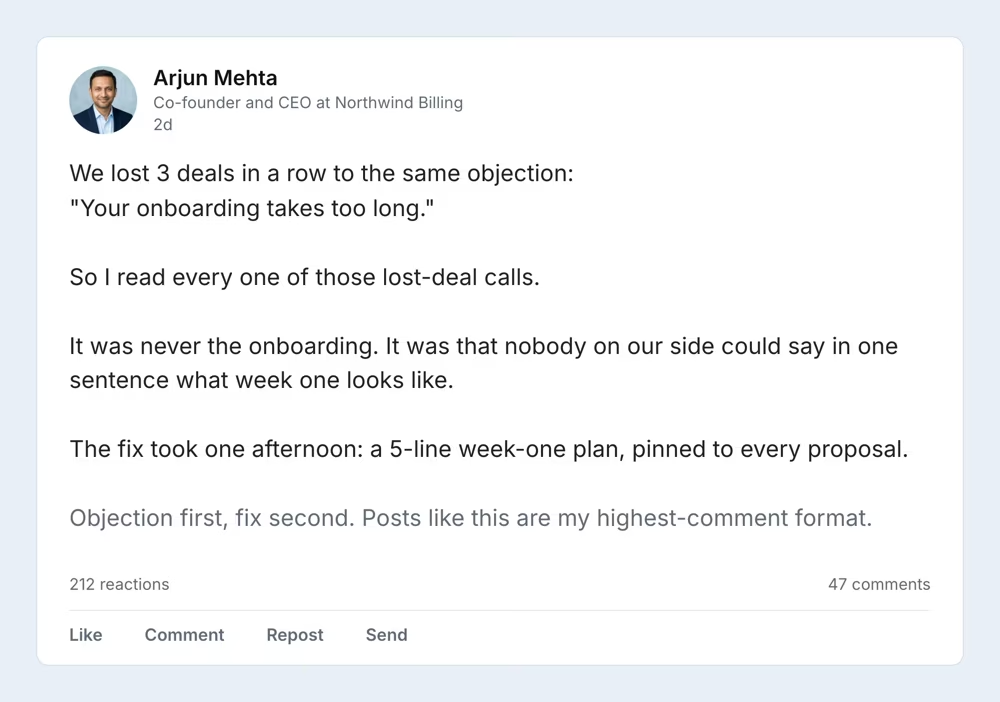
Pattern 1: the founder opinion tied to a lost deal
A founder post works when it starts from a real objection and ends with a fix, in under 150 words. It carries the point of view pillar and costs the founder one sentence per deal lost.
Pattern 2: the data post from your own accounts
A data post turns internal numbers into a chart a buyer can scan in five seconds. It carries the problem pillar, and the figure should answer one question only. Use your own data and label it with the sample size.
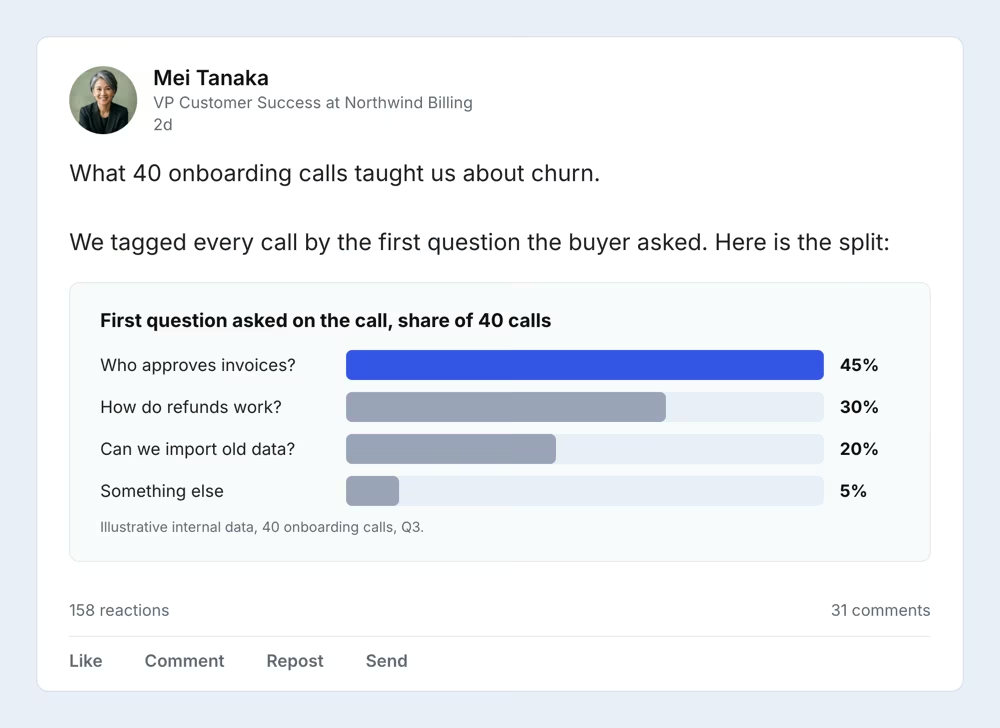
Pattern 3: the rep teardown as a document post
A teardown answers one buyer question step by step, so the next prospect with the same question finds the answer before asking. It is the format that turns sales knowledge into pipeline-ready content, and a document post lets the reader swipe through the steps.
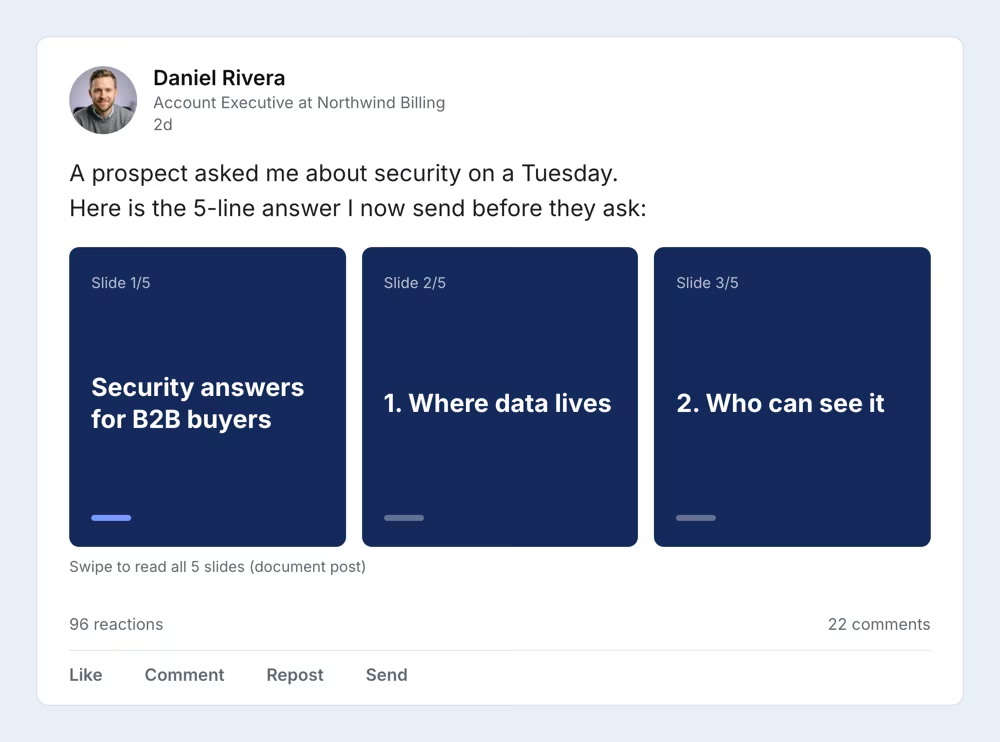
To adapt a pattern, keep its structure and swap the substance. Replace the lost deal with the objection your sales team hears most. Replace the onboarding data with a count from your own support tickets or calls. Replace the security answer with the question your technical reviewer asks first. The structure is what the audience recognizes, and the substance is what makes it yours.
Each pattern uses a different pillar and a different voice, which is the point. A strategy that rotates formats and voices stays readable to the same buying group for months.
A one-page B2B content strategy template
A B2B content strategy fits on one page with six boxes: audience, pillars, voices, cadence, next step and measurement. If a decision does not fit in a box, it is not yet a decision. Fill the template in a 60-minute workshop with marketing, sales and one executive.
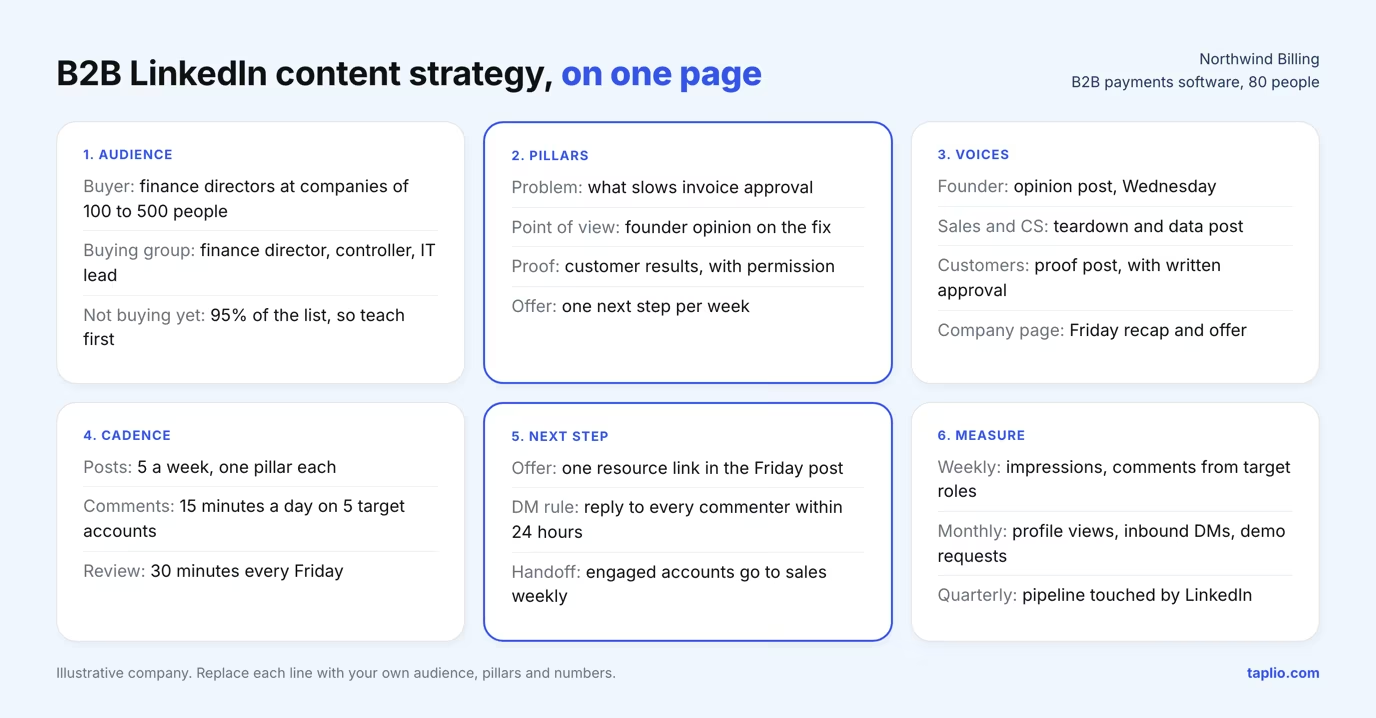
Fill the boxes in this order:
- Audience. Name the buying group by role and company size, and state how much of it is not buying yet.
- Pillars. Pick three or four from the table above, each with a buyer problem.
- Voices. Put a named person on every pillar and a time budget next to the name.
- Cadence. Fix the posting days and the daily comment slot.
- Next step. Decide the one offer, the DM reply rule and the handoff to sales.
- Measure. Choose one weekly, one monthly and one quarterly number.
Run the workshop with three rules. Marketing writes, sales corrects, and the executive decides when the room disagrees. Print the page, put it on the wall of the team room and bring it to every Friday review. A page nobody sees is not a strategy.
Review the page every quarter and cut any pillar that produced no comments from target roles.
Measure what the strategy is for
A B2B LinkedIn strategy is measured by audience quality and pipeline touched, not by impressions alone. Start with three layers of metrics and read each at its own pace, so a slow week does not trigger a strategy change.
| Layer | Metric | Read it | Decision it drives |
|---|---|---|---|
| Attention | Impressions, comments from target roles | Weekly | Which format to repeat |
| Intent | Profile views, inbound DMs, resource clicks | Monthly | Which pillar to expand or cut |
| Pipeline | Demo requests and deals touched by LinkedIn | Quarterly | Whether to keep the budget |
To judge whether a post is strong for your size, compare it with a benchmark rather than with last week. Taplio's LinkedIn Benchmark measures 54,000+ posts in its August 2026 edition and shows where the median sits in your follower bracket and what the top 10% do differently.
Set targets after four weeks of data, not before. Record the weekly count of comments from target roles for a month, then set the next target at 20% above the average of that month. A target built on your own baseline is realistic, and a target copied from a blog post is not.
Self-reported attribution fills the gap that analytics cannot see. Much of the effect of a LinkedIn post happens in private chats and in people's heads, so add a required field to the demo form that asks how the buyer heard about you, and read the free-text answers every month. Answers such as "saw your CEO post" are the signal that the strategy works.
For your own accounts, use a LinkedIn analytics tool that breaks results down by post and by account, so each voice can see its own numbers.
Know what to do when a number dips. If comments from target roles fall for two weeks, change the format before the pillar. If they stay low for six weeks across formats, the pillar is wrong or the audience is, and the fix is a new buyer problem, not a longer post. Change one variable at a time, so you know which change moved the result.
Keep a simple log with the date, the pillar, the format and the result of each post. After a quarter the log tells you which pillar earns attention and which one only fills the calendar.
Mistakes that stall a B2B content strategy
Six mistakes explain most stalled B2B plans, led by no named owner, too many pillars, offers in every post and no review date. Each one is fixed in the one-page template, which is why the template comes before the calendar.
- No named owner. A pillar without a person and a time budget produces posts for two weeks, then none.
- Too many pillars. Seven topics give the audience nothing to remember. Cut to four.
- Offers in every post. Speaking only to the 5% in market loses the 95% who would have remembered you.
- No review date. Put a 30-minute Friday review and a quarterly pillar review on the calendar before the first post.
- Copying a competitor's calendar. A calendar built for another company's buyers answers questions your buyers do not ask.
- Ignoring comments. Unanswered comments waste the strongest signal the plan produces and teach commenters to stop.
Fix them in that order. Naming owners and cutting pillars takes one meeting and removes most of the risk.
Frequently asked questions
What are some examples of B2B content marketing?
Common B2B content marketing formats are blog guides, case studies, white papers, industry reports, webinars, newsletters and LinkedIn posts. On LinkedIn the formats that carry the most weight for B2B teams are founder opinion posts, customer proof, data from your own accounts and document posts that answer one buyer question.
What is the 3 3 3 rule in sales?
The 3 3 3 rule usually means 3x3 research: spend three minutes to find three facts about a prospect, spanning their company, their role and their team, before you reach out. Some teams use the same name for other rules, such as 3 calls, 3 emails and 3 social touches over 3 weeks, so define it inside your team before you use it.
What is the 70-20-10 rule in digital marketing?
In content marketing it is a planning split of 70% proven formats, 20% variations of what works and 10% new experiments. It is a heuristic, not a research result, and sources disagree on its origin. Use it to keep room for testing, then adjust the ratio to your own results.
What is a B2B marketing content strategy template?
It is a one-page document that records the audience, the pillars, the voices, the cadence, the next step and the metrics of a B2B content plan. The template in this guide uses six boxes and a one-line answer per decision, so a marketing lead can fill it in during a 60-minute workshop and review it every quarter.
What are the 5 main strategies of digital marketing?
The five most common are search engine optimization, content marketing, social media marketing, email marketing and paid advertising. A B2B content strategy on LinkedIn sits inside social media marketing and content marketing, and it feeds the other three with ideas, proof and warm audiences.


Keep reading
All articlesRelated Articles




Your Linkedin AI coach is waiting for you
Join 12,000+ creators who let their coach turn the blank page into a plan and watch their audience compound.
7-day free trial · Cancel anytime