
Pricing


AI writer

Taplio
MCP V2
New: Engage tools
Taplio MCP V2 now available, try it out
Your AI can now comment and reply for you. It finds the posts worth engaging, drafts in your voice and queues them on your Taplio account. Nothing posts until you confirm.

Thought leadership: definition and what it looks like on LinkedIn


11
min read

 Open in ChatGPT
 Open in Claude
 Open in Perplexity

Key Takeaways
- Thought leadership definition: Thought leadership is publishing original ideas that change how people in a field think and being credited for them; it is judged by whether others adopt the idea, and on LinkedIn it shows up in 5 recurring post patterns rather than in generic tips.
- What it looks like on LinkedIn: Original data, a contrarian view backed by experience, a named framework, a lesson from a failure and a dated prediction, each built on proof the author holds and published as 1 repeated idea.
- The number that decides: 75% of decision-makers and C-suite executives say a piece of thought leadership led them to research a product or service they were not considering, according to the 2024 Edelman and LinkedIn B2B Thought Leadership Impact Report.
- What to check before posting: The idea is yours, the claim is specific enough to disagree with, the proof comes from your own work, and the reader gets a concrete next step.
- Where to start: Choose 1 idea and 2 post patterns, publish weekly and review monthly, and add Thought Leader Ads only once organic posts earn replies; Taplio, from $39 per month with a 7-day free trial and no free plan, helps draft and schedule but cannot supply the idea.
Thought leadership is the practice of publishing original ideas that change how people in your field think, and being credited for them. On LinkedIn, it looks like posts that carry a point of view only you could write: your own data, a position backed by experience, a framework, a lesson from a failure or a dated prediction. It is judged by whether others adopt your ideas, not by how often you post.
What is thought leadership?
Thought leadership is original thinking that other people repeat, cite or argue with, attributed to you. A thought leader is someone whose ideas shape how a field talks about its problems. The test is adoption, so a post can be well written and still not qualify.
The label itself is a business one. It is usually traced to strategy+business, the Booz Allen magazine launched in 1994, which ran what it called Thought Leader interviews, according to its founding editor Joel Kurtzman.
Three tests separate thought leadership from ordinary posting:
- Original: the idea, data or method comes from your own work, not from a summary of someone else's.
- Specific: a reader can disagree with it, which means it names a claim instead of a topic.
- Useful: the reader leaves knowing what to do or decide differently.
Thought leadership vs content marketing, personal brand and influence
Thought leadership is the only one of the four that is defined by ideas. Content marketing is defined by what a company publishes, a personal brand by what people expect from you, and influence by how many people pay attention. They overlap in practice, which is why they get confused.

| Concept | What it is built on | How you know it works | Can it exist without the others? |
|---|---|---|---|
| Thought leadership | An original idea or finding | Others repeat and credit it | Rarely: it needs some audience to spread |
| Content marketing | A publishing schedule and a buyer journey | Traffic, leads, pipeline | Yes: it can run without any original idea |
| Personal brand | Your name and a consistent reputation | People know what you stand for | Yes: a clear brand can sit on borrowed ideas |
| Influence | Reach and a responsive audience | Audience size and response | Yes: reach does not require new thinking |
If you are starting from your reputation rather than your ideas, the guide to what a personal brand is covers that side. Thought leadership is what you add on top once you have something original to say.
What thought leadership looks like on LinkedIn
On LinkedIn, thought leadership is a stream of posts and comments that all return to the same idea, written by someone with first-hand proof. It rarely looks like a single viral post. It looks like a recognizable position held over months.
Four signals tell it apart from generic posting:
- A repeated idea: the same claim shows up in different forms across posts, so a reader can name what you stand for.
- First-hand proof: numbers, decisions and mistakes from your own work, not a recap of an industry report.
- A stated stake: the post says what you think and what would change your mind.
- A conversation around it: peers reply with their own cases, and the author answers.
It also helps to know what it is not. A list of ten tips anyone could have written is content. A congratulation post is networking. A repost with "great read" is curation. All three are fine to publish, none of them builds a position. For ways to find angles that are yours, the list of LinkedIn post ideas is a good starting point.
Thought leadership examples on LinkedIn: five patterns to copy
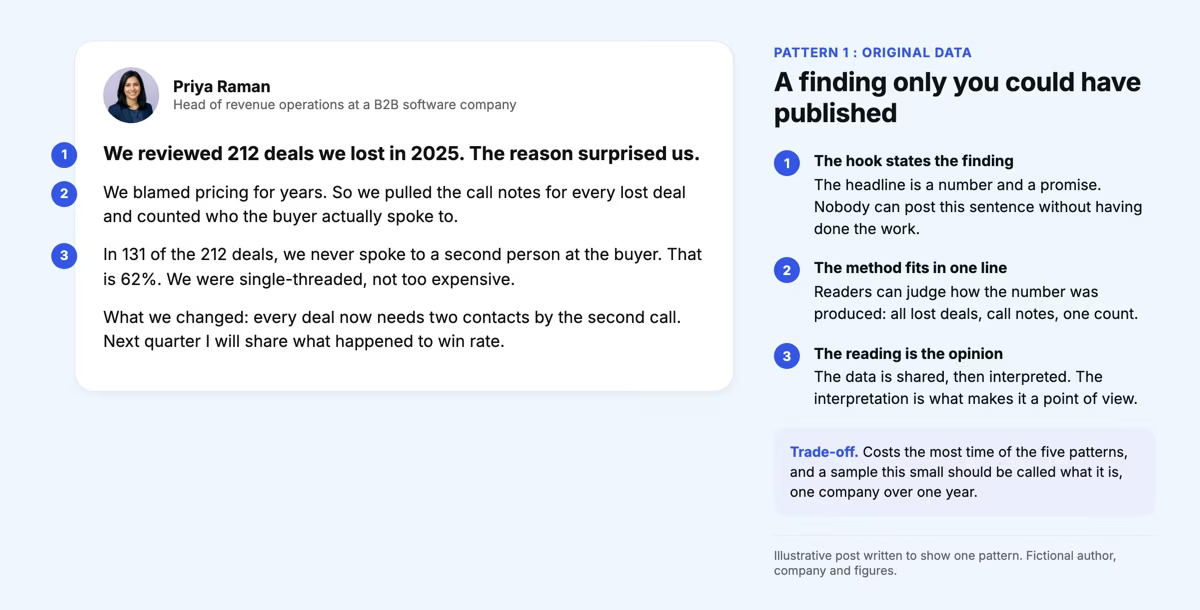
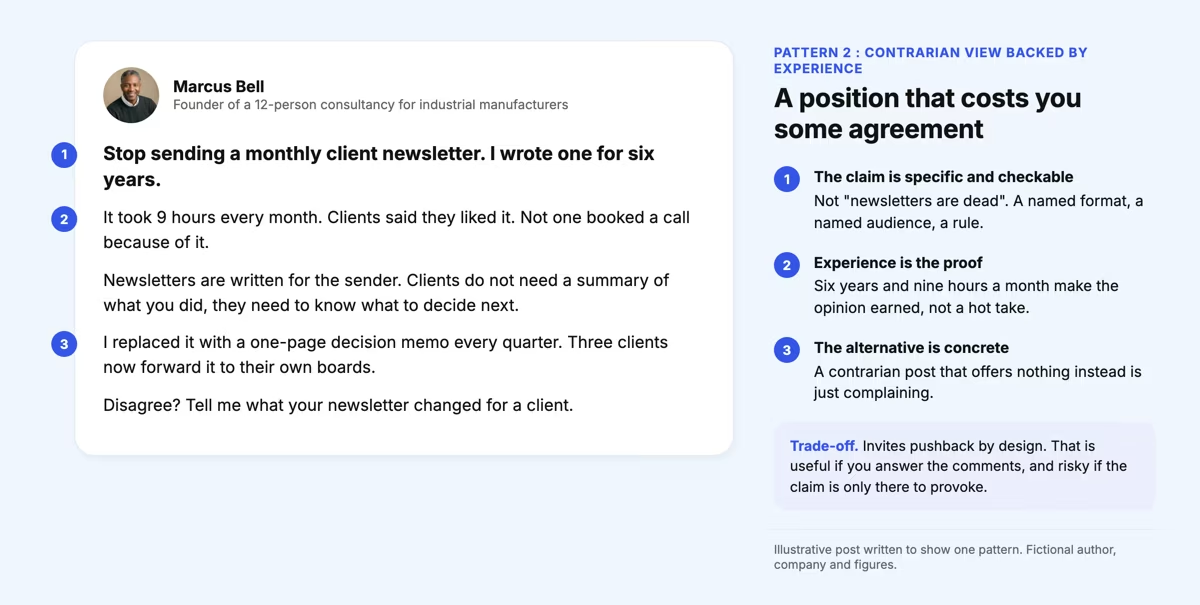
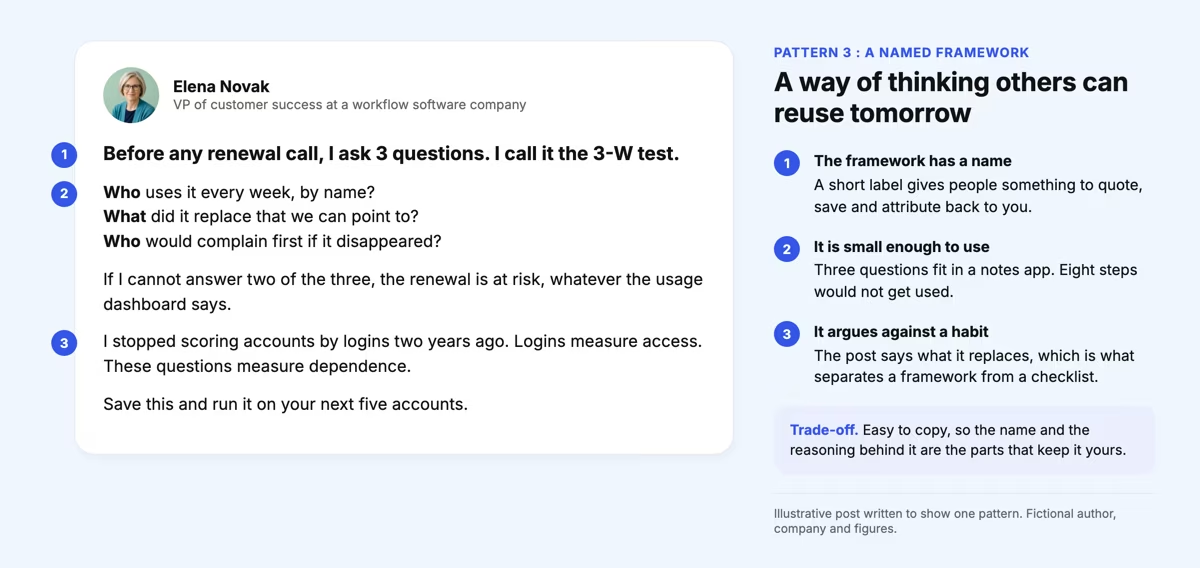
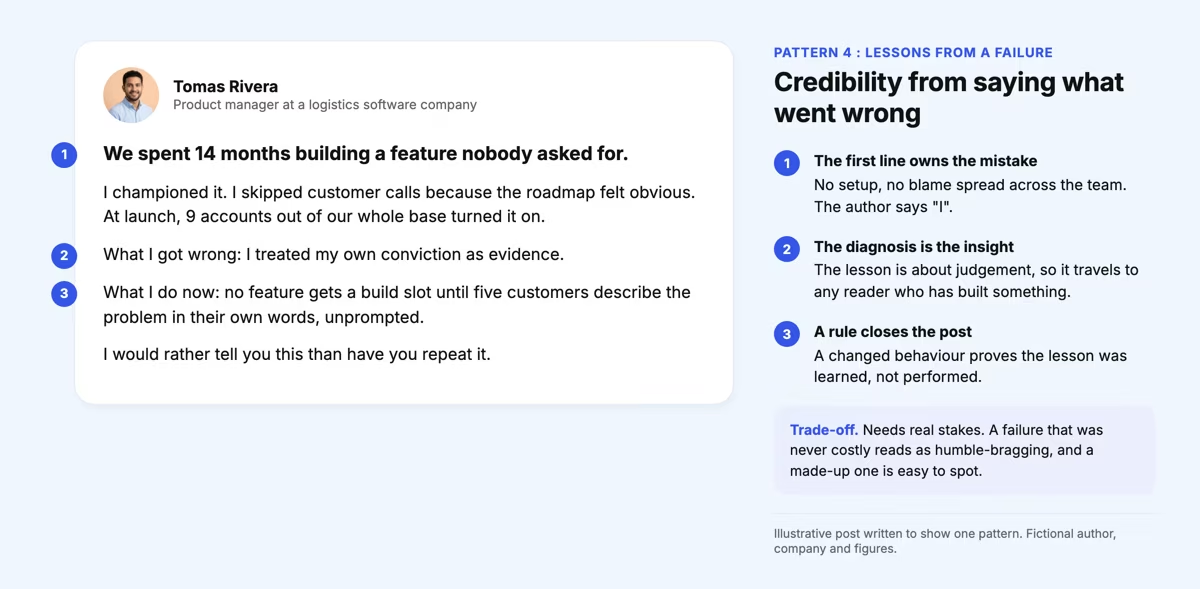
Five post patterns carry most LinkedIn thought leadership: original data, a contrarian view backed by experience, a named framework, a lesson from a failure and a dated prediction. Each one below is a rendered LinkedIn-style post by a different fictional professional. The authors, companies and figures are invented to demonstrate the pattern, not real results.
Pattern 1: original data
Share a finding from your own records and say how you got it. It costs the most time and carries the most proof, because nobody else holds your numbers.
Pattern 2: a contrarian view backed by experience
Take a position against a common habit and earn it with years of doing the thing. The claim must be specific and the alternative concrete, or it reads as complaining.
Pattern 3: a named framework
Give a way of thinking a short name and keep it small enough to use tomorrow. The name is what people save, quote and attribute back to you.
Pattern 4: lessons from a failure
Start with the mistake in the first line and say "I". The insight is the diagnosis of your own judgment, which travels to any reader who has built something.
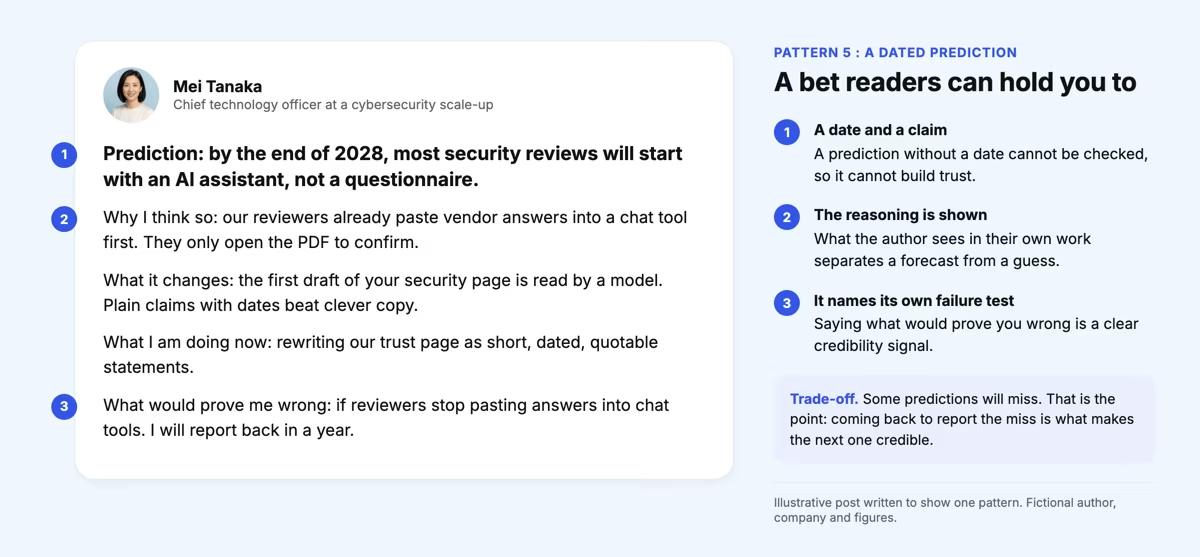
Pattern 5: a dated prediction
Make a claim with a date, show the reasoning from your own work, and name what would prove you wrong. Coming back to report the result is what makes the next prediction credible.
What buyers say makes thought leadership credible
Buyers rate strong research and data, an understanding of their problems and concrete guidance as the marks of good thought leadership. In the 2024 Edelman and LinkedIn B2B Thought Leadership Impact Report, 55% of decision-makers cited strong research and data as a top characteristic of high-quality thought leadership, according to LinkedIn's write-up of the findings.
The same write-up shows why the effort is worth it. 75% of decision-makers and C-suite executives said a particular piece of thought leadership led them to research a product or service they were not previously considering, and 70% of C-suite leaders said it had at least occasionally made them question an existing supplier. It also shows the bar is not cleared often: fewer than half of respondents rated the overall quality of the thought leadership they read as good, and only 15% rated it very good.
Two things follow for a LinkedIn author. Proof you hold, such as your own data, beats opinion alone. And the takeaway has to come early, because the report cites past research in which 55% of buyers move on if a piece does not interest them within the first minute.
How to build a thought leadership strategy on LinkedIn
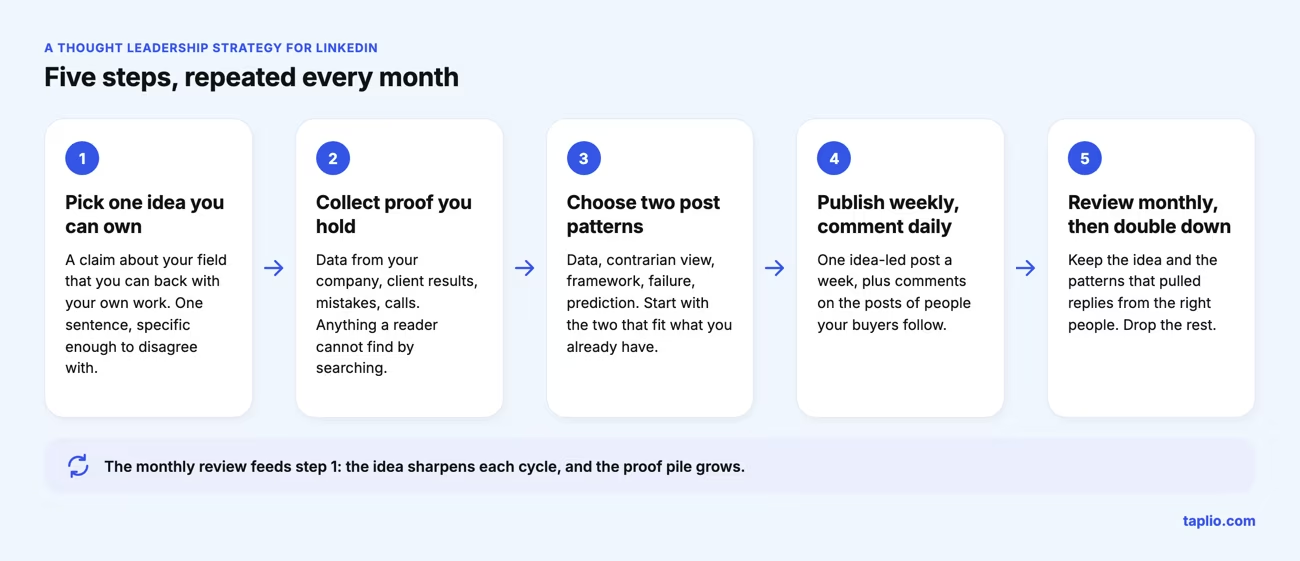
A workable strategy is one idea, backed by proof you hold, shown in two post patterns, published weekly and reviewed monthly. Start narrow. You can widen the range of topics after the first idea has been repeated enough to be recognized.
Pick one idea you can own
Write it as one sentence that someone could disagree with. If nobody could disagree, it is a topic, not an idea. "Customer success should score accounts on dependence, not logins" is an idea. "Customer success matters" is not.
Collect the proof you hold
List what you have that a reader cannot find by searching: data from your company, client results, decisions that went wrong, patterns from calls. Each item is raw material for a post, and the list tells you which patterns you can start with.
Match the idea to two post patterns
Pick the two patterns that fit what you already have. If you hold data, start with original data and a framework. If you hold a hard-won lesson, start with a failure post and a prediction. A weekly cadence keeps the idea visible:
| When | What you do | Why |
|---|---|---|
| Once a week | Publish one idea-led post in one of your two patterns | The same claim from a new angle builds recognition |
| Daily, 15 minutes | Comment on posts from people your buyers follow | Your point of view reaches audiences you do not have yet |
| Within a day of each post | Reply to every substantive comment | The conversation is part of the proof |
| Once a month | Review which posts drew replies from the right people | Keep the idea, drop the patterns that did not land |
Make the routine easy to keep
Consistency is where most efforts stop. Taplio, from $39 per month with a 7-day free trial, helps you draft, queue and schedule posts so the weekly rhythm survives a busy week. The idea and the proof still have to come from you, and the LinkedIn post generator works best when you feed it your own material.
If you lead a company, the same approach scales to a team. The page on corporate influencers explains how Taplio supports leaders who publish on behalf of an organization.
Where Thought Leader Ads fit
Thought Leader Ads let a company pay to promote a member's post, with the author's permission. Per LinkedIn's Help Center, the member's profile must show their full name, the post must be public, and reposts, documents and polls are not eligible. They amplify posts that already earn replies, so they come after the organic work, not instead of it.
How to tell if your thought leadership is working
You can tell it is working when people repeat your idea without prompting. Impressions are a weak signal because a post can reach thousands and change nobody's mind. Watch for the evidence of adoption instead:
- Replies that build on the point: comments from peers adding their own cases, not just reactions.
- Quotes and attribution: your framework named in someone else's post, a talk or an internal document.
- Inbound that cites a post: messages and meeting requests that mention something you published.
- The right people engaging: buyers and peers you wanted to reach, not only other creators.
Use your own results as the baseline and compare against the field only for context. Taplio's LinkedIn Benchmark measures a fresh sample of real posts every month by follower bracket, which helps you judge whether a change is yours or platform-wide. Judge the idea over a quarter, not a week, because recognition builds slowly.
Frequently asked questions
What are examples of thought leadership?
On LinkedIn, five patterns recur: a post built on your own data, a contrarian view backed by experience, a named framework, a lesson from a failure and a dated prediction. Off LinkedIn the same ideas appear as original research reports, conference talks, books and columns. What they share is a point of view that the author earned and others can reuse.
How do you demonstrate thought leadership?
Publish a specific claim, back it with proof only you hold, and keep returning to the same idea for months. Then show that others use it: replies that build on your point, people quoting your framework, inbound messages that cite a post. Credentials help, but repeated, useful ideas are what demonstrate it.
What is another word for thought leader?
Close alternatives are subject-matter expert, authority, visionary, pioneer and opinion leader. They are not exact synonyms. A subject-matter expert knows a field, while a thought leader also shapes how the field talks about its problems.
Is Elon Musk a thought leader?
It depends on the test you apply. If thought leadership means original ideas that others adopt and credit to you, the question is whether his specific ideas changed how people in a field think. If it means attention, that is influence, a different thing, so no single answer applies to every field.
What is the definition of thought leadership?
Thought leadership is the practice of publishing original ideas that change how people in your field think, and being credited for them. It is judged by adoption of the idea, not by posting volume or follower count.



Keep reading
All articlesRelated Articles




Your Linkedin AI coach is waiting for you
Join 12,000+ creators who let their coach turn the blank page into a plan and watch their audience compound.
7-day free trial · Cancel anytime